What Is Cognitive Function: A Simple Guide to How Your Brain Works
Have you ever walked into a room and completely forgotten why you went there? Or maybe you've struggled to focus on a single task while your phone buzzes nearby? These aren't just moments of forgetfulness; they are glimpses into your brain's operating system. This system is known as cognitive function, and it powers everything from your memory to your ability to solve complex problems at work.
This guide simplifies the science behind how your brain works. You will learn the clear definition of cognitive function in psychology, explore its six main domains, and understand the factors that affect your mental performance. Finally, we will show you how establishing a baseline with a cognitive function test can help you manage your brain health proactively.
The Scientific Definition: What Is Cognitive Function in Psychology?
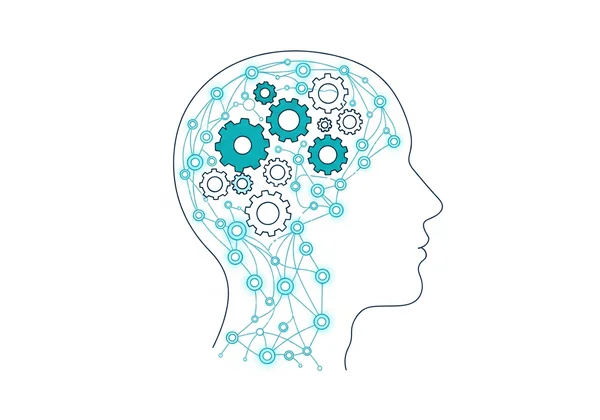
Understanding cognitive function starts with separating scientific fact from pop culture fiction. In the simplest terms, what is cognitive function? It refers to the mental processes that allow us to carry out any task. It is the brain's ability to learn, think, reason, remember, problem-solve, and make decisions.
Without these functions, you wouldn't be able to process information from the world around you or interact with it meaningfully. It is not a static trait; it is a dynamic set of skills that can fluctuate based on your health, age, and lifestyle.
Simple Meaning: More Than Just "Thinking"
Many people use the word "thinking" to describe all mental activity. However, cognitive function is more specific. It breaks down "thinking" into distinct mechanics.
- Perception: Taking in information through your senses.
- Processing: Making sense of that information.
- Action: Deciding what to do with it.
For example, when you see a red light while driving, your perception sees the color, your processing understands it means "stop," and your action tells your foot to hit the brake. All of this happens in milliseconds thanks to cognitive function.
Cognitive Function vs. Intelligence (IQ): The Key Differences
It is easy to confuse cognitive function with intelligence (IQ), but they are not the same thing.
- IQ (Intelligence Quotient) largely measures your potential to learn and understand complex ideas. It is often considered relatively stable throughout adulthood.
- Cognitive Function measures how well your brain is performing specific tasks right now.
Think of IQ as the hardware of a computer (the processor speed), while cognitive function is how well the software is running. Even a fast computer can run slowly if it has too many programs open or hasn't been rebooted in a while. Similarly, a high-IQ individual can experience poor cognitive function due to stress or lack of sleep.
Clarification: Clinical Psychology vs. MBTI Personality Types
A common point of confusion arises from the Myers-Briggs Type Indicator (MBTI), which uses terms like "Dominant Cognitive Functions" (e.g., Introverted Intuition or Extraverted Feeling).
Important Note: This article discusses cognitive function in the context of clinical psychology and neuroscience—memory, attention, and executive function. We are not referring to personality preferences or MBTI types. Understanding this distinction is crucial for anyone looking to evaluate their actual brain health rather than their personality traits.
The 6 Main Domains of Cognitive Function
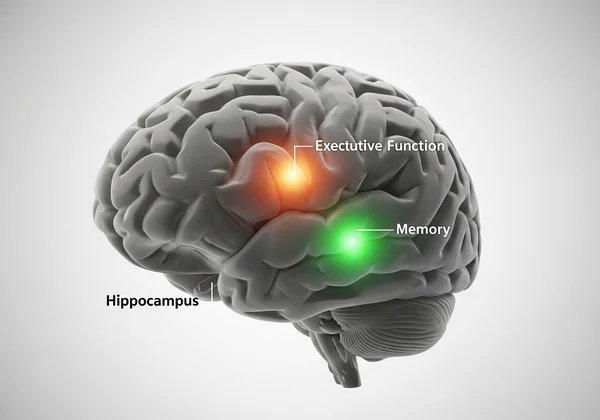
Neuroscientists typically categorize cognitive abilities into six core domains. Each domain relies on different cognitive function brain areas, though they often work together seamlessly.
Memory: Working, Short-term, and Long-term
Memory is more than just recalling the past.
- Working Memory: The ability to hold information in your mind while using it (e.g., doing mental math).
- Short-term Memory: Remembering a phone number just long enough to dial it.
- Long-term Memory: Storing information for days, years, or a lifetime.
Attention & Focus: The Brain’s Filter
This domain controls your ability to concentrate on a specific stimulus while ignoring distractions. It includes:
- Sustained Attention: Focusing on one task for a long time.
- Selective Attention: Listening to a friend in a noisy crowded room.
Executive Function: Planning and Decision Making
Located primarily in the frontal lobe, this is the "CEO" of the brain. It handles high-level tasks such as:
- Planning your day.
- Controlling impulses.
- Flexible thinking (switching between tasks).
Visuospatial, Language & Processing Speed
-
Visuospatial Perception: Helps you understand where objects are in space (crucial for driving or parking).
-
Language: The ability to find the right words and understand grammar.
-
Processing Speed: How quickly your brain can take in information and respond.
Cognitive Functioning Examples in Daily Life
To truly grasp what is cognitive function, let's look at cognitive functioning examples in everyday scenarios. You use these skills constantly without realizing it.
Driving a Car: A Complex Web of Perception and Reaction
Driving is one of the most cognitively demanding tasks we do.
- Visuospatial: Judging the distance between your car and the one ahead.
- Attention: Watching the road while ignoring the radio.
- Processing Speed: Reacting instantly to a pedestrian stepping off the curb.
- Executive Function: Navigating a new route while following traffic laws.
At Work: Multi-tasking and Problem Solving
In a professional setting, your executive functions are in high gear.
- Working Memory: Remembering instructions from your boss while opening the necessary files on your computer.
- Inhibition: Resisting the urge to check social media so you can finish a report.
- Planning: Breaking a large project into manageable daily steps.
Social Interactions: Reading Cues and Memory
Even chatting with a friend requires complex cognition.
- Social Cognition: Reading facial expressions and tone of voice.
- Long-term Memory: Recalling shared experiences from the past.
- Language: Choosing the right words to express empathy.
What Affects Cognitive Function? (Factors & Signs)
Your brain's performance isn't set in stone. Many factors can influence what affects cognitive function, causing it to sharpen or dull over time.
Lifestyle Killers: Stress, Lack of Sleep, and Diet
Before assuming you have a serious medical issue, look at your lifestyle.
- Sleep: Lack of deep sleep prevents the brain from "cleaning house," leading to brain fog.
- Chronic Stress: High cortisol levels can actually shrink the hippocampus, the brain's memory center.
- Diet: High-sugar and processed food diets are linked to inflammation that slows down cognitive processing.
Normal Aging vs. Mild Cognitive Impairment (MCI)
As we age, it is normal for processing speed to slow down slightly. This is often called "normal cognitive aging." However, what is impaired cognitive function?
- Normal Aging: You forget a name but remember it later. You misplace keys occasionally.
- Mild Cognitive Impairment (MCI): You forget important appointments frequently. You have trouble following the plot of a movie you usually enjoy. Friends or family notice the changes.
Checklist: Signs Your Cognitive Function May Be Shifting
Use this checklist for self-reflection. These are not diagnostic criteria but signals to pay attention to.
- Do you often lose your train of thought in the middle of a conversation?
- Is it becoming harder to follow recipes or multi-step instructions?
- Do you feel overwhelmed by making small decisions?
- Do you have trouble finding common words more often than before?
- Has your ability to focus on reading a book decreased significantly?
If you checked multiple boxes, it might be time to look deeper into your cognitive health.
How to Improve Cognitive Function
The good news is that the brain is plastic—it can change and adapt. Here is how to improve cognitive function through daily habits.
Physical Exercise: The Best Brain Booster
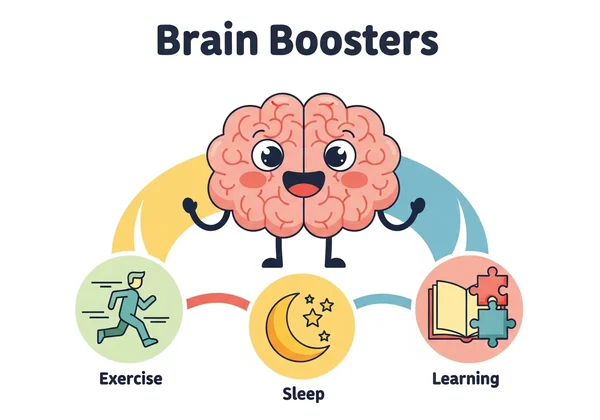
Aerobic exercise (like walking, swimming, or cycling) increases blood flow to the brain. Studies show it can actually increase the size of the hippocampus, boosting memory and learning. Aim for at least 150 minutes of moderate activity per week.
Mental Stimulation & Continuous Learning
"Use it or lose it" applies to your neurons.
-
Learn a new skill: Try a new language or musical instrument.
-
Socialize: Engaging in meaningful conversation is a high-level cognitive workout.
-
Variety: Break your routines. Take a different route to work to force your brain to navigate actively.
The Importance of Establishing a Cognitive Baseline
We track our weight, our blood pressure, and our bank accounts. Yet, we rarely measure the most important organ in our body until there is a problem.
Why You Can't Manage What You Don't Measure
You cannot know if your cognitive function is declining if you don't know where it started. Establishing a "baseline" gives you a reference point. If you feel foggy in six months, you can re-test and compare the data to see if there is an objective change or if it's just a bad week.
How Our AI-Driven Tool Works
CognitiveAssessment.net offers a way to measure cognitive performance objectively. Unlike a subjective "how do you feel" quiz, an assessment tool tests your actual performance on tasks involving memory, attention, and reasoning. It provides a clear snapshot of your current capabilities.
Start Your Journey: Get Your Personal Cognitive Profile
Understanding your brain is the first step toward optimizing it. Whether you want to improve your focus at work or simply monitor your brain health as you age, getting a baseline is an empowering choice.
You can explore our cognitive function test to start building your personal profile today. It is a helpful educational resource to see where your strengths lie.
Summary: Empower Your Brain Through Understanding
What is cognitive function? It is the engine of your daily life. From the moment you wake up to the decisions you make at work, your cognitive domains are hard at work. While factors like stress and aging can impact performance, your brain remains resilient and adaptable. By understanding how it works and proactively measuring your baseline, you take control of your mental longevity.
If you are curious about your current brain health, we invite you to explore our cognitive function assessment to gain deeper insights.
Frequently Asked Questions
What is the simplest definition of cognitive function?
The simplest definition is that cognitive function refers to the mental skills you use to learn, think, remember, and pay attention. It is how your brain processes information and helps you interact with the world.
Can stress and anxiety affect my cognitive test results?
Yes, absolutely. Stress hormones can block memory retrieval and scatter your focus. If you are going through a highly stressful period, your cognitive performance may temporarily dip.
Is cognitive decline reversible?
It depends on the cause. Decline caused by vitamin deficiencies, sleep deprivation, or stress is often reversible with lifestyle changes. Conditions like dementia are progressive, but early detection and management can help maintain quality of life.
How often should I test my cognitive function?
For most healthy adults, checking in once a year is a good rhythm to track changes over time. If you are actively trying to improve specific skills, you might test more frequently, such as every 3 to 6 months.
Is cognitive function the same as an IQ test?
No. An IQ test measures potential and general intelligence, which is relatively stable. Cognitive function tests measure your current performance in specific areas like memory and attention, which can fluctuate based on health and lifestyle.