Psychology Definition of Cognition: Meaning, Types, and Examples
The psychology definition of cognition is the set of mental processes people use to take in information, interpret it, store it, retrieve it, and use it to guide behavior. In simpler terms, cognition is how the mind works with information: noticing, remembering, understanding, deciding, solving problems, and adjusting plans. That is why cognition is a central word in psychology, cognitive science, education, psychiatry, medicine, and philosophy. If you are trying to understand your own attention, memory, or thinking patterns, an educational online cognitive self-check can also give you a structured way to reflect on several cognitive skills at once.
This article explains cognition in plain English, then connects the definition to cognitive psychology, everyday examples, common types of cognition, and health-adjacent contexts where careful wording matters.
How Cognition Is Best Defined in Psychology
In psychology, cognition is best defined as information processing by the mind and brain. The word covers both quick automatic operations and slower deliberate thinking. You use cognition when you recognize a face, follow a conversation, compare two choices, remember an appointment, understand a sentence, or pause before reacting.
A useful psychology definition of cognition includes several parts:
- Input: perception and attention help select information from the environment.
- Processing: thinking, reasoning, and interpretation give that information meaning.
- Storage: memory keeps information available for later use.
- Output: decisions, language, problem-solving, and actions show cognition in behavior.
This definition is broad because cognition is not one single skill. It is a family of mental processes that work together. For example, reading a message involves visual perception, attention, language comprehension, working memory, prior knowledge, and decision-making. If any one part is overloaded, the whole task can feel harder.
The term can also be used at different levels. A textbook may discuss cognition as a general system. A clinician may describe cognitive status or cognitive change. A researcher may study a single process, such as attention or memory encoding. In all cases, the core idea is the same: cognition is how information becomes understanding, judgment, and action.
Cognition vs Cognitive vs Cognitive Psychology
People often search for cognition vs cognitive because the words look almost identical. Cognition is the noun. It refers to the mental processes themselves. Cognitive is the adjective. It describes something related to those processes.
For example, memory is a cognitive process. A task that measures attention is a cognitive task. A change in problem-solving may be called a cognitive change. The underlying thing being discussed is cognition.
Cognitive psychology is a field of psychology that studies those mental processes scientifically. A simple definition of cognitive psychology is: the branch of psychology concerned with how people perceive, attend, remember, learn, think, solve problems, use language, and make decisions. It is not exactly the same as cognition. Cognition is the subject matter; cognitive psychology is one discipline that studies it.
This distinction also helps with related search terms. A definition of cognitive development in psychology usually refers to how thinking and understanding change across the lifespan, especially in childhood and adolescence. A definition of cognitive neuroscience in psychology points to the relationship between mental processes and brain systems. A definition of cognitive therapy in psychology refers to a therapy approach that examines thought patterns, beliefs, emotions, and behavior. These phrases share the adjective cognitive, but they are not interchangeable.
Types of Cognition in Psychology
There is no single universal list of exactly three or four types of cognition, which is why search results can vary. Psychology courses, medical resources, and assessment tools group cognitive abilities in different ways. Still, several core domains appear repeatedly.
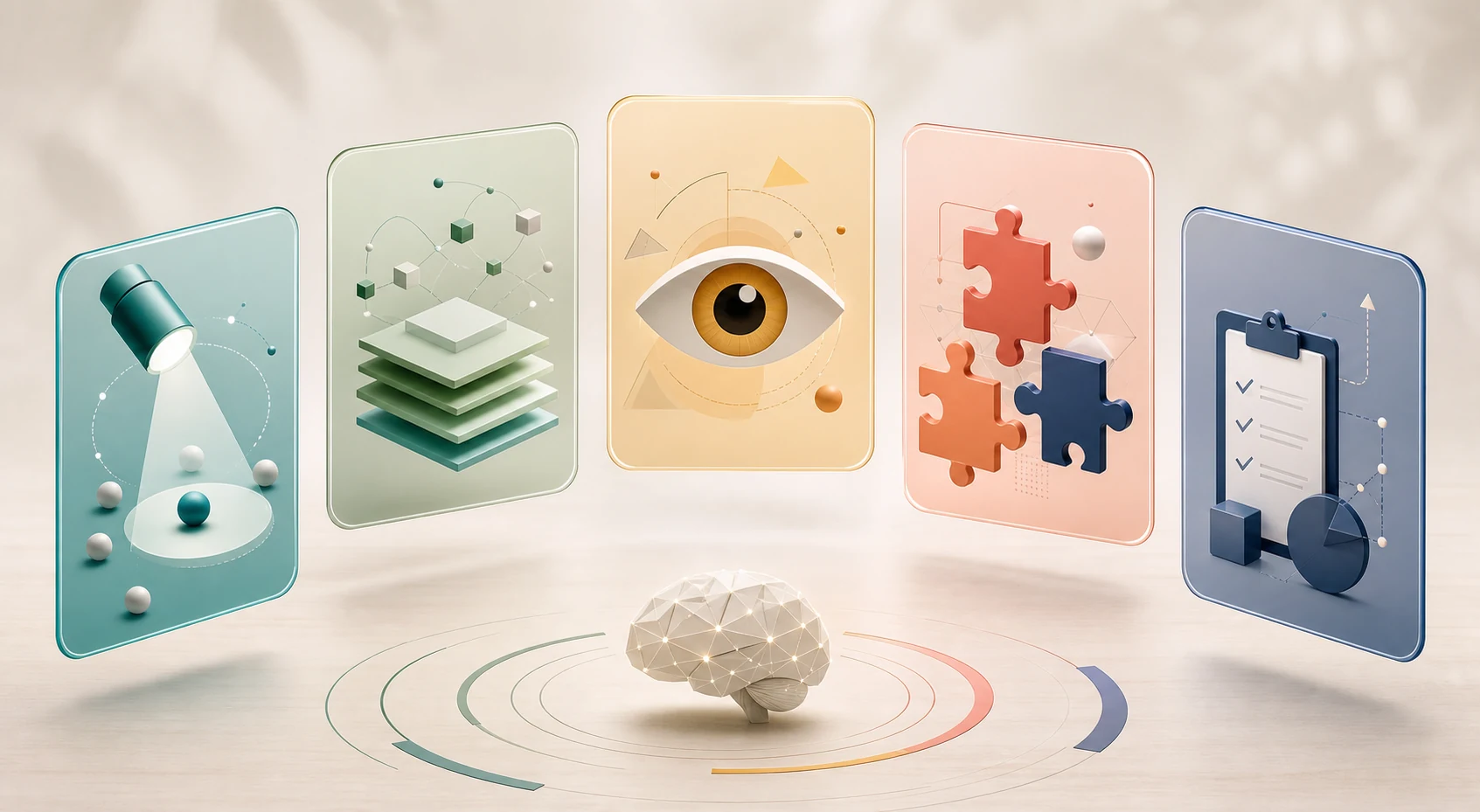
Four common types of cognition are attention, memory, perception, and reasoning. If someone asks, "What are the 4 types of cognition?" this is a practical answer for general learning. Attention helps you select what matters. Memory helps you hold and retrieve information. Perception helps you interpret sensory input. Reasoning helps you draw conclusions and solve problems.
Another common three-part grouping is attention, memory, and executive function. This is useful when discussing daily performance because these domains strongly affect work, study, planning, and self-monitoring. Executive functions include skills such as inhibition, mental flexibility, sequencing, and goal management.
A fuller psychology-oriented list may include:
- Attention: focusing, shifting, dividing, and sustaining mental effort.
- Memory: encoding, storing, retrieving, and manipulating information.
- Perception: organizing sensory information into meaningful patterns.
- Language: understanding and producing words, sentences, and meaning.
- Learning: changing knowledge or behavior through experience.
- Reasoning: making inferences, evaluating evidence, and solving problems.
- Executive functions: planning, prioritizing, controlling impulses, and adapting.
- Processing speed: how efficiently a person handles familiar mental operations.
An educational platform that looks across memory, attention, processing speed, and executive functions can help users see cognition as a pattern rather than a single score. That is the value of a multi-domain cognitive assessment overview when it is used for reflection and not as a substitute for professional evaluation.
Examples of Cognition in Everyday Life
An example of cognition in psychology does not need to be dramatic. Cognition is active during ordinary moments. When you choose the fastest route to work, you use memory, spatial reasoning, prediction, and decision-making. When you keep a phone number in mind long enough to type it, you use working memory. When you ignore a distracting notification to finish a paragraph, you use attention and inhibitory control.

Here are more concrete cognition examples:
- Remembering why you walked into a room.
- Understanding a joke from context.
- Comparing prices while shopping.
- Following a recipe while monitoring timing.
- Switching from one work task to another.
- Recognizing that you misunderstood an instruction and correcting course.
- Planning what to say in a difficult conversation.
These examples show why cognition is closely tied to daily function. Cognition is not limited to intelligence, academic ability, or test-taking. It is involved in self-regulation, social understanding, routine tasks, and adapting to new information.
Cognition in Medical, Psychiatry, and Philosophy Contexts
The cognition definition in medical contexts often emphasizes mental functions such as memory, orientation, attention, language, problem-solving, and judgment. Medical professionals may discuss cognition when evaluating neurological conditions, medication effects, sleep problems, injuries, aging, or changes in daily functioning. Because health context matters, a self-guided article or online score should be treated as educational information, not a clinical conclusion.
In psychiatry, cognition can refer to both general mental processes and the content or style of thoughts. For example, psychiatry may consider how attention, memory, executive functioning, beliefs, mood, and perception interact. This is one reason cognitive symptoms can appear in discussions of depression, anxiety, psychosis, ADHD, Parkinson's disease, dementia, traumatic brain injury, and other conditions. The presence of cognitive changes does not identify a cause by itself. If someone notices persistent, sudden, worsening, or safety-related changes, a qualified professional is the right next step.
Does Parkinson's affect cognition? Parkinson's disease can be associated with changes in attention, executive functioning, processing speed, memory retrieval, or visual-spatial skills for some people. The pattern and severity vary, and only a trained clinician can interpret symptoms in context.
The cognition meaning in philosophy is broader and more conceptual. Philosophy often asks what it means to know, believe, perceive, reason, understand, or be conscious. While psychology studies cognition through observation, experiments, and measurement, philosophy examines the nature and limits of knowledge, thought, and mind. The two areas overlap, but their methods and questions are different.
How Cognition Relates to Assessment and Self-Reflection
Because cognition includes many processes, no single activity captures everything. A memory task may say something about recall or working memory, but it may not say much about language comprehension. A speeded task may reflect processing efficiency, but it can also be influenced by sleep, stress, distractions, vision, motor speed, or unfamiliar instructions.
That is why cognitive assessment is most helpful when interpreted carefully. Educational self-assessments can help people organize observations: which tasks feel easy, which feel effortful, and whether a pattern changes over time. They can also encourage better questions, such as "Is my attention worse late in the day?" or "Do I struggle more with planning than remembering?"
Formal clinical evaluation goes further. It may include interviews, standardized tools, medical history, observation, and professional interpretation. Online tools should not replace that process. Still, a reflective multi-domain cognitive check can be useful when someone wants a structured starting point for thinking about memory, attention, processing speed, and executive functions.
Using the Psychology Definition of Cognition Wisely
The most useful psychology definition of cognition is practical: cognition is how your mind receives, manages, stores, and uses information. It includes attention, perception, memory, language, learning, reasoning, processing speed, and executive control. It also shows up constantly in daily life, from reading and planning to conversations and decisions.
When you see terms such as cognitive psychology, cognitive development, cognitive neuroscience, cognitive therapy, or cognitive perspective, remember that cognitive means "related to cognition." The exact meaning depends on the field and context. A psychology course may emphasize experiments and theory. A medical setting may emphasize mental status and functioning. A philosophy discussion may emphasize knowledge and mind.
For personal reflection, it is usually better to think in patterns rather than labels. Notice which cognitive tasks feel strong, which feel inconsistent, and what conditions affect them. Sleep, mood, stress, practice, health, environment, and task design can all change performance. If you want a structured but low-pressure way to organize those observations, you can explore an educational cognitive assessment and use the results as one input for reflection, not as a final answer.
FAQ
How is cognition best defined?
Cognition is best defined as the mental processing of information. It includes perceiving, paying attention, remembering, learning, using language, reasoning, solving problems, and making decisions.
What are the 4 types of cognition?
A common four-part answer is attention, memory, perception, and reasoning. Some psychology and health resources use different groupings, so the exact list depends on the purpose of the discussion.
What are the three types of cognition?
A practical three-part grouping is attention, memory, and executive function. This grouping is common when people want to understand everyday performance, planning, focus, and mental effort.
What is an example of cognition in psychology?
Following a recipe is a good example. You use attention to stay on task, memory to hold steps in mind, perception to monitor food and tools, and executive function to adjust timing.
What is the difference between cognition and cognitive psychology?
Cognition is the set of mental processes. Cognitive psychology is the branch of psychology that studies those processes, including attention, memory, language, learning, reasoning, and decision-making.
What does cognition mean in philosophy?
In philosophy, cognition often refers to knowing, believing, perceiving, reasoning, understanding, and the nature of thought. Philosophy asks conceptual questions about mind and knowledge, while psychology studies cognition with empirical methods.
Can Parkinson's affect cognition?
Parkinson's disease can be associated with cognitive changes for some people, especially in attention, processing speed, executive functioning, memory retrieval, or visual-spatial skills. A clinician should evaluate individual concerns.