Online vs. Clinical Cognitive Testing: Which Is Right For You?
In recent years, more and more people are paying attention to their brain health. You might be wondering about your own memory or focus, or perhaps you're supporting a loved one. With so many options available, a key question often arises: Should I use an online cognitive test or seek a professional clinical evaluation?
Understanding the difference is crucial for making an informed decision. This guide will walk you through the landscape of cognitive testing, comparing online tools with traditional clinical methods. We will explore the benefits and limitations of each, helping you choose the right path for your needs.
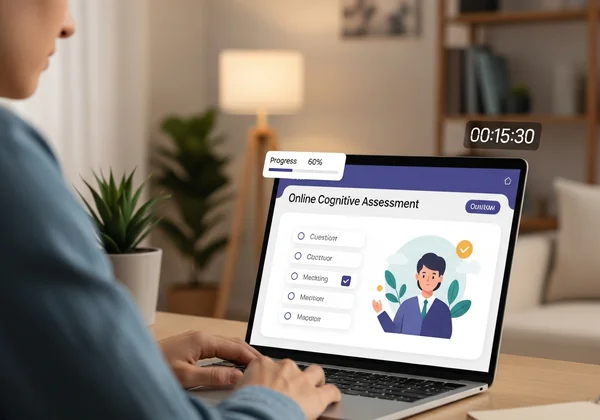
For those looking to get a quick and insightful baseline of their cognitive skills, an online assessment can be an excellent first step. Our AI-powered platform offers a comprehensive, accessible way to understand your cognitive profile from the comfort of your home. You can start your assessment today to gain valuable insights.
Understanding the Landscape of Cognitive Assessments
Before comparing online and clinical options, it's helpful to understand what a cognitive assessment is and why someone might need one. This foundation will help you see where each type of test fits into the bigger picture of managing your cognitive health.
What Is a Cognitive Assessment and When Is It Needed?
A cognitive assessment is a way to measure your brain's performance in key areas. These areas include memory, attention, problem-solving, language skills, and processing speed. Think of it as a check-up for your mind, providing a snapshot of your cognitive strengths and weaknesses.
People seek cognitive assessments for many reasons. Some are lifelong learners who want to optimize their mental performance for work or study. Others may be concerned about age-related memory changes or want to monitor their cognitive health proactively. For some, an assessment is a response to noticing specific difficulties in daily life, like forgetting appointments or struggling to follow conversations.
Types of Cognitive Assessments: From Self-Administered Tests to Clinical Evaluations
Cognitive assessments exist on a spectrum, from simple online quizzes to in-depth clinical evaluations. At one end, you have self-administered tools like the ones available online. These are designed for ease of use and can provide a broad overview of your cognitive functions.
At the other end is the comprehensive neuropsychological evaluation. This is conducted by a trained professional, such as a neuropsychologist, and involves a battery of standardized tests in a controlled setting. These evaluations are thorough, highly detailed, and are considered the "gold standard" for diagnosing cognitive conditions.
Online Cognitive Assessments: Benefits and Limitations
The rise of digital health has made online cognitive testing more popular than ever. These tools offer a convenient and modern approach to understanding your brain function. Let's explore the advantages and potential drawbacks of this option.
The Advantages of AI-Driven Online Testing
Modern online cognitive assessments offer significant benefits. This is especially true for those powered by Artificial Intelligence. One of the biggest advantages is accessibility. You can take a test from anywhere with an internet connection, removing barriers like travel and long waiting lists for appointments.
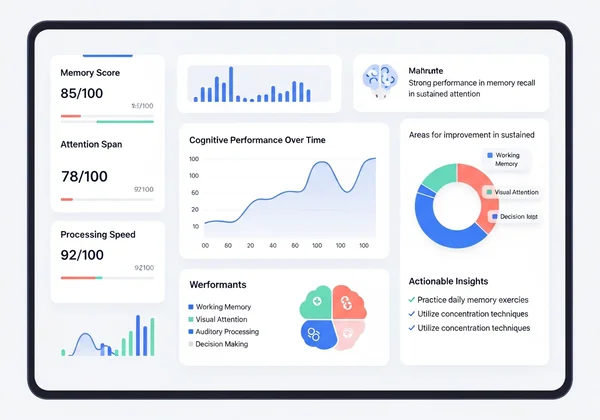
AI-driven platforms also offer unparalleled precision and personalization. Our AI engine analyzes your unique response patterns. It goes beyond simple scores to identify subtle patterns. This provides a detailed report with actionable insights into your cognitive strengths and challenges. This level of detail was previously only available through extensive professional analysis. Furthermore, these tests are often affordable or free, making them an excellent tool for regular brain health checks.
When Online Assessments Fall Short: Recognizing Their Limitations
It's equally important to be transparent about the limitations of online tests. The primary limitation is that they are screening tools, not diagnostic instruments. An online assessment cannot diagnose conditions like Alzheimer's disease, dementia, or ADHD. A formal diagnosis requires a comprehensive evaluation by a qualified healthcare professional who can consider your full medical history.
Additionally, the uncontrolled environment of at-home testing can affect results. Distractions or even your mood on a given day can influence your performance. While powerful, these tools are best used for gaining self-awareness, tracking changes over time, and getting a baseline understanding—not for making medical decisions.
Professional Neuropsychological Testing: The Gold Standard
When serious concerns arise or a formal diagnosis is needed, professional neuropsychological testing is the necessary next step. This process is conducted by a clinical expert and provides the most definitive and comprehensive look at cognitive function.
What Happens During a Clinical Cognitive Evaluation?
A clinical evaluation is a multi-step process. It typically begins with a detailed interview where a neuropsychologist asks about your symptoms, medical history, education, and daily life. This context is vital for interpreting the test results accurately.
The testing itself involves a series of standardized, often paper-and-pencil tasks administered one-on-one. These tests are rigorously designed to measure specific cognitive domains in great detail. The entire evaluation can take several hours and may be spread over more than one session. Afterward, the psychologist analyzes the results to create an extensive report that may include a diagnosis and treatment recommendations.
Clinical vs. Online: Key Differences in Depth and Scope
Clinical and online testing differ primarily in depth and purpose. A clinical evaluation is diagnostic; it aims to identify the underlying cause of cognitive difficulties. An online test is a screening tool; it aims to provide insights and identify potential areas of concern that might warrant further investigation.
Think of it like this: an online test is like taking your temperature at home with a thermometer. It gives you a quick, useful piece of data. If your temperature is very high, you know you need to see a doctor. The clinical evaluation is the doctor's visit, where they run multiple tests to figure out why you have a fever and how to treat it. Both are valuable, but they serve different roles in your health journey. For a preliminary check, an online cognitive assessment is a powerful place to start.

Making the Right Choice: A Decision Framework
So, how do you decide which path is right for you? Your choice depends on your goals, your symptoms, and your current situation. Here is a simple framework to help you make the right decision.
Red Flags That Warrant Professional Evaluation
Certain signs and symptoms should prompt you to seek a professional clinical evaluation without delay. These "red flags" suggest that a simple screening may not be sufficient. You should consult a doctor or specialist if you or a loved one experiences:
- Significant memory loss that disrupts daily life (e.g., forgetting names of close family, getting lost in familiar places).
- Sudden and unexplained changes in personality or mood.
- Difficulty with planning, problem-solving, or completing familiar tasks.
- Problems with language, such as struggling to find the right words or follow a conversation.
- Concerns raised by a doctor or a close family member about your cognitive abilities.
If any of these apply, a professional evaluation is the most appropriate course of action.
When Online Testing Provides Valuable Insights
Online cognitive assessments are an excellent choice in many other scenarios. They are particularly valuable if your goal is self-improvement, proactive brain health monitoring, or getting an initial baseline. Consider using an online tool if you:
- Are curious about your cognitive strengths and weaknesses.
- Want to track your cognitive performance over time, perhaps in response to lifestyle changes.
- Are a student or professional looking to optimize your focus and learning abilities.
- Have mild concerns about your memory or attention and want an objective, data-driven starting point.
In these cases, an AI-powered tool provides a safe, insightful, and accessible way to explore your cognitive profile. It can empower you with knowledge and suggest practical steps for improvement. Ready to gain clarity? You can try our free tool right now.
Taking the First Step in Your Cognitive Health Journey
The choice between online assessment and clinical evaluation becomes clearer when you understand their distinct purposes. Clinical testing is the gold standard for diagnosis when significant concerns are present. Online testing is a powerful, accessible tool for self-awareness, proactive monitoring, and personal growth.
For many, the journey to better cognitive health starts with a single step: gaining a clearer understanding of where you stand today. An online assessment provides a confidential, detailed, and data-driven snapshot of your mental abilities. It can empower you with the knowledge to make positive changes or help you decide if seeking professional advice is the right next step.
Your cognitive health is one of your most valuable assets. Begin your journey to better cognitive health today with a simple, confidential assessment. Visit our platform to start your comprehensive test and receive your personalized AI-driven report today.

Frequently Asked Questions About Cognitive Testing Options
What is the difference between online cognitive tests and professional neuropsychological testing?
The main difference is purpose and depth. Online tests are screening tools designed for self-assessment, providing insights into your cognitive profile. Professional testing is a diagnostic process conducted by a clinician to identify the cause of cognitive issues and provide a formal diagnosis.
When should I consider getting a professional cognitive assessment instead of using an online tool?
You should seek a professional assessment if you experience significant symptoms that interfere with your daily life, such as major memory loss, personality changes, or difficulty with basic tasks. If a doctor or loved one has expressed serious concerns, a clinical evaluation is the best course of action.
Can online cognitive assessments detect conditions like Alzheimer's or dementia?
No. Online assessments are not diagnostic tools and cannot detect or diagnose any medical condition, including Alzheimer's or dementia. They can, however, identify areas of cognitive weakness that might prompt you to seek a professional medical opinion. Our platform always includes a clear disclaimer for this reason.
How accurate are online cognitive assessment tools compared to clinical evaluations?
Clinically validated online tools can be very accurate in measuring cognitive performance. Our AI-powered platform uses principles from established neuropsychological tests to ensure reliable results. However, they do not replace the comprehensive diagnostic accuracy of a full clinical evaluation, which includes a professional's interpretation and consideration of your complete medical history.
What are the warning signs that I should seek professional cognitive testing?
Key warning signs include memory loss that disrupts daily life, difficulty planning or solving problems, confusion with time or place, and sudden changes in mood or personality. If you are experiencing these, it is important to consult a healthcare professional. For those with milder concerns or a desire for a baseline, an online cognitive test is an ideal starting point.