Definition Cognitive Psychology: Meaning, Core Ideas, and Everyday Examples
The shortest useful definition cognitive psychology students can remember is this: cognitive psychology is the scientific study of mental processes, including attention, perception, memory, language, reasoning, problem-solving, and decision-making. It asks how people take in information, transform it, store it, retrieve it, and use it in everyday life. That makes the field different from a simple list of brain skills. It is a way of explaining how thinking works while people read, learn, plan, notice distractions, compare choices, or remember instructions. If you are exploring your own attention, memory, or thinking patterns, an online cognitive self-check can give you a structured starting point for reflection, while formal health questions still belong with qualified professionals.
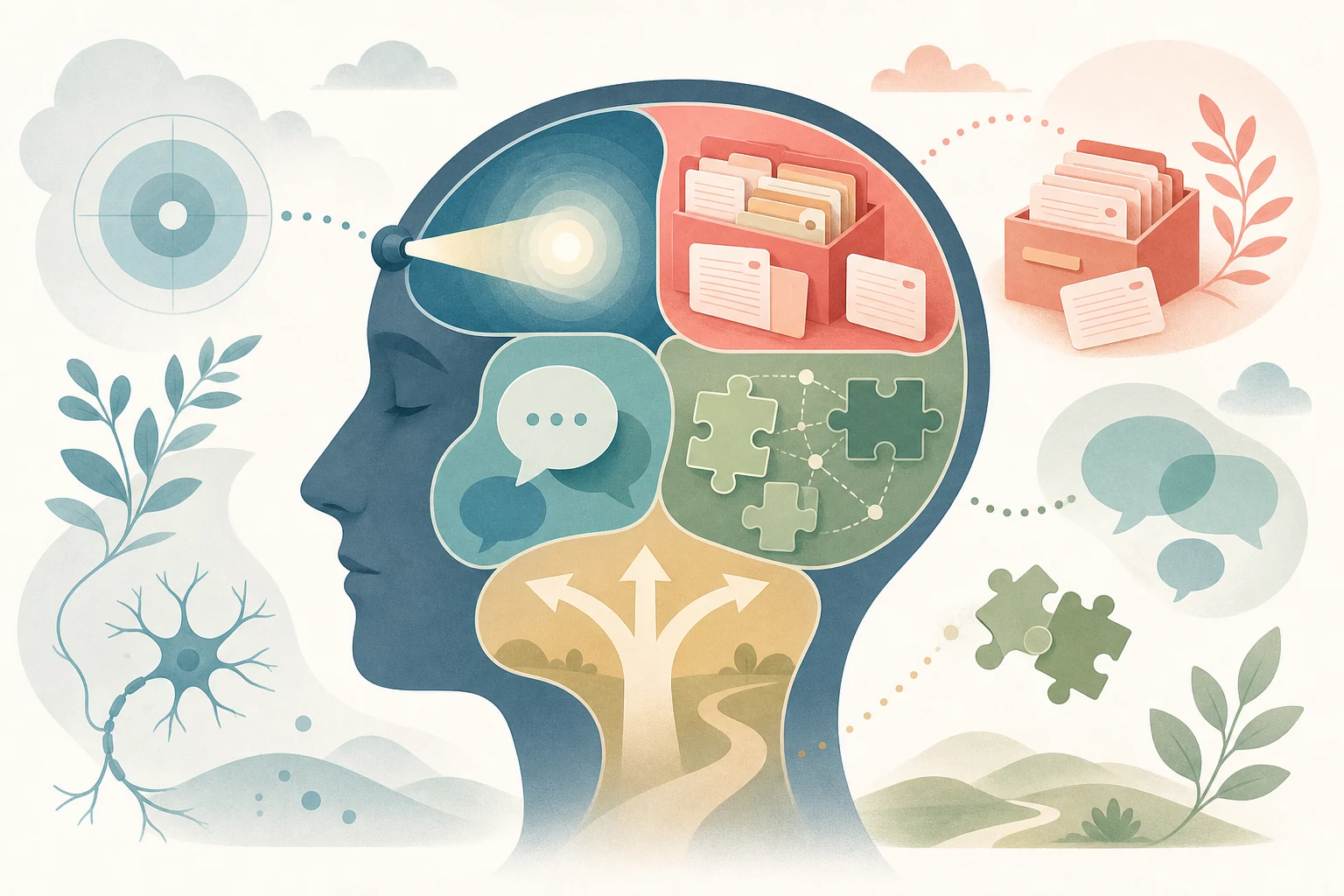
What Is the Definition of Cognitive Psychology?
A clear cognitive psychology definition starts with cognition. In psychology, cognition refers to mental activity related to knowing and using information. That includes noticing a sound, recognizing a face, keeping a phone number in mind long enough to type it, understanding a sentence, choosing between two tasks, and learning from feedback. Cognitive psychology studies those internal operations in a scientific way.
The field does not treat the mind as vague or unknowable. Instead, it uses careful experiments, behavioral measures, reaction time, accuracy, memory tasks, language tasks, computational models, and sometimes brain-based methods to make mental processes easier to study. Researchers may not see a thought directly, but they can observe patterns in how people respond, how long a task takes, what errors appear, and how performance changes with context.
In simple notes, cognitive psychology is the part of psychology that studies how people think. A fuller version is that it studies the processes that let people acquire, organize, remember, and apply information. This is why common definitions often mention perception, attention, memory, language, reasoning, and problem-solving together. Those skills overlap constantly. Reading a paragraph, for example, requires visual perception, attention control, word knowledge, working memory, inference, and long-term memory.
Cognitive Psychology vs. Cognition, Cognitive Science, and Biological Psychology
The phrase "cognitive" can be confusing because it appears in several related fields. Cognition is the broad set of mental processes. Cognitive psychology is the psychological study of those processes. Cognitive science is wider and often includes psychology, neuroscience, linguistics, philosophy, computer science, and artificial intelligence. Cognitive neuroscience focuses more directly on how brain systems support mental activity.
Cognitive and biological psychology also overlap, but they ask different main questions. Biological psychology emphasizes the nervous system, hormones, genetics, and physiological mechanisms behind behavior and mental life. Cognitive psychology emphasizes information processing: what the person perceives, attends to, stores, retrieves, interprets, and decides. A biological psychologist might ask which neural systems are involved in attention. A cognitive psychologist might ask why divided attention slows reading or why memory improves when information is organized into meaningful groups.
Neither approach cancels the other. Modern psychology often combines them. A cognitive approach can describe the mental steps involved in a task, while biological methods can explore the brain activity that supports those steps. Together, they help explain why the same person can feel mentally sharp in one setting and overloaded in another.
The Fundamental Ideas in Cognitive Psychology
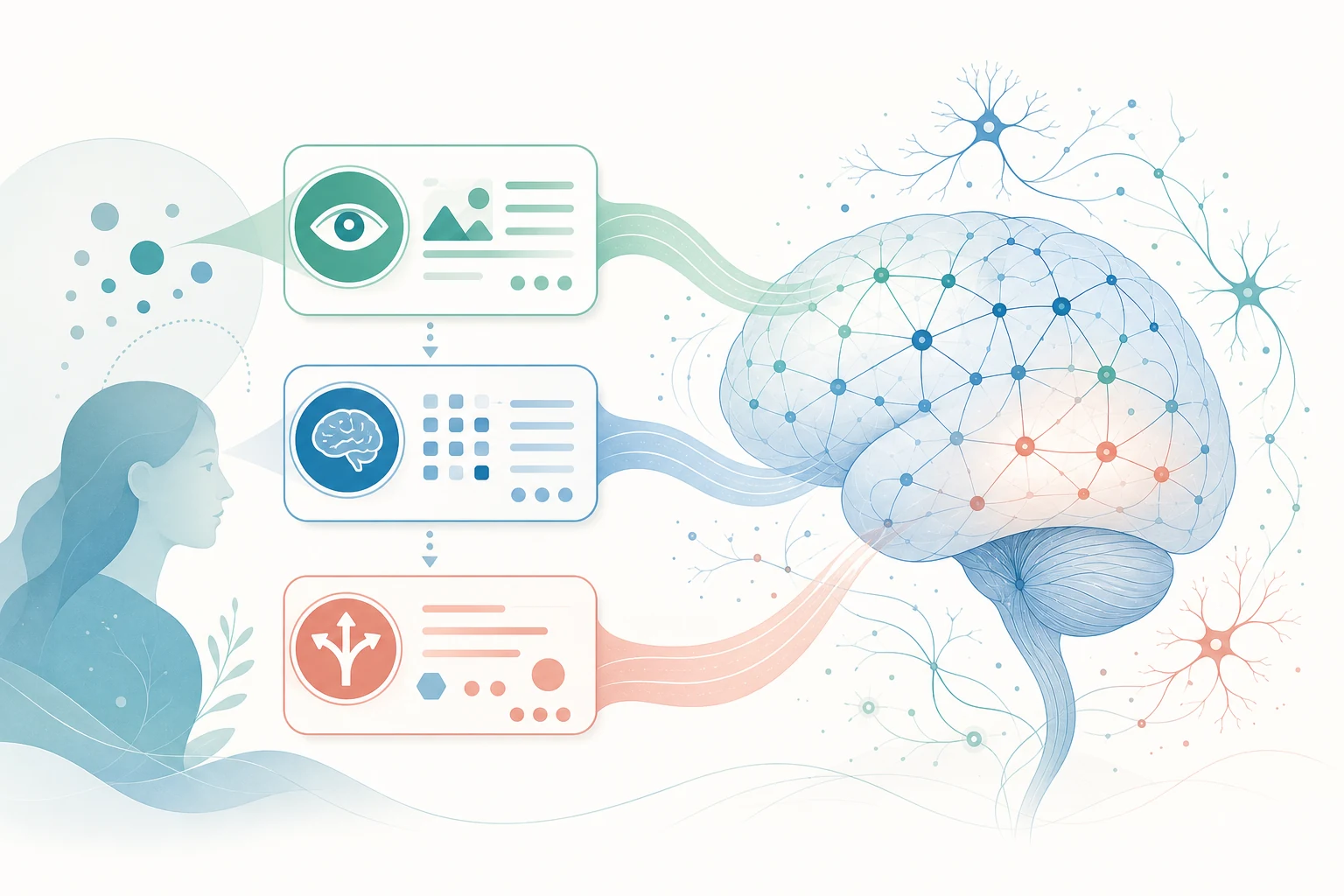
The first fundamental idea is information processing. Cognitive psychologists often describe the mind as a system that receives input, selects what matters, transforms it, stores parts of it, and uses it to guide action. The computer metaphor influenced this idea during the cognitive revolution in psychology, but the human mind is not literally a computer. People bring goals, emotion, prior knowledge, expectations, fatigue, and social context into every task.
The second idea is limited capacity. Attention and working memory are powerful, but they are not unlimited. That is why a person can follow a conversation in a quiet room but struggle in a noisy restaurant, or remember three instructions but lose track after eight. Cognitive load psychology studies how the amount and complexity of information can strain mental resources.
The third idea is active interpretation. Perception is not a passive recording of the world. The mind organizes sensory information into meaningful patterns. Gestalt psychology helped shape this idea by showing that people tend to perceive organized wholes, not just disconnected parts. This matters for learning, design, and daily judgment because what people notice depends partly on how information is arranged.
The fourth idea is memory as a set of processes. Memory involves encoding, storage, and retrieval. Forgetting can happen because information was never encoded well, because cues are weak, because similar memories interfere, or because attention was divided. This is why cognitive psychology lessons often teach strategies such as spacing, retrieval practice, chunking, and meaningful association.
The fifth idea is mental representation. People use internal models, concepts, schemas, maps, images, words, and expectations to make sense of the world. A cognitive map, for example, is a mental representation of an environment or relationship pattern. A schema is an organized knowledge structure that helps people interpret new information quickly, though it can also create bias.
A Short History: From Gestalt to the Cognitive Revolution
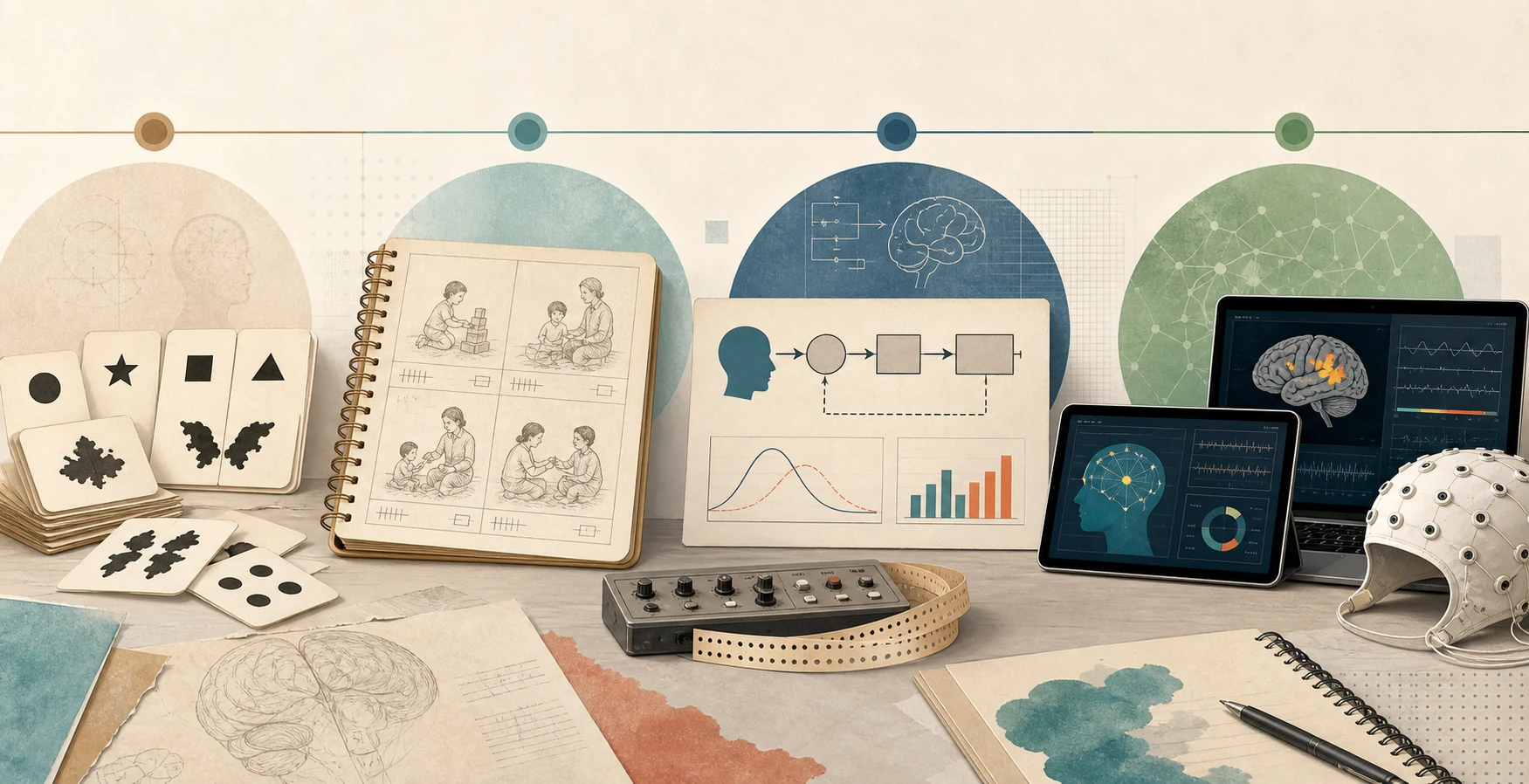
Cognitive psychology did not appear from nowhere. Early work in perception, memory, and problem-solving set the stage. Gestalt psychologists argued that people organize experience into meaningful patterns, which challenged the idea that perception was only a sum of tiny sensations. Their work still shows up in design, learning, and visual attention.
Behaviorism then became highly influential in the early and mid twentieth century. Behaviorists focused on observable behavior and often avoided claims about internal mental life because it seemed difficult to measure. This approach produced important research on learning, reinforcement, and behavior, but it left many questions about memory, language, and reasoning underexplained.
The cognitive revolution in psychology changed that balance. From the 1950s through the 1970s, researchers drew on information theory, computer science, linguistics, and experimental methods to study mental processes more directly. Ulric Neisser's work helped popularize the term cognitive psychology, and research on attention, memory models, language, and problem-solving grew quickly. The key shift was not that behavior stopped mattering. The shift was that psychologists developed better ways to study the hidden mental steps behind behavior.
Everyday Examples of Cognitive Psychology
Cognitive psychology becomes easier to understand when you connect it to ordinary moments. Imagine opening a new app for the first time. Perception helps you identify icons and layout. Attention helps you focus on the next action. Working memory lets you hold the goal in mind while navigating menus. Long-term memory helps you recognize familiar patterns from other apps. Decision-making helps you choose whether to save, skip, or explore.
Another example is studying for an exam. Cognitive learning psychology asks how information is encoded and retrieved. Rereading may feel fluent, but retrieval practice often reveals whether you can actually bring the idea back without prompts. Spaced practice usually supports better long-term retention than one long session because it gives memory repeated opportunities to rebuild access routes.
Driving in traffic is also cognitive. You monitor signs, predict other drivers, inhibit distractions, update your route, judge speed, and switch attention. If you are tired, stressed, or overloaded, those processes may become slower or more error-prone. That does not mean one difficult day defines your ability. It means cognitive performance is shaped by task demands and context.
For users who want a structured way to reflect on memory, attention, processing speed, and executive functions, CognitiveAssessment.net's multi-domain cognitive assessment can help organize observations into a clearer snapshot. The results should be treated as educational information, not a formal clinical evaluation.
How the Cognitive Approach Explains Attention, Memory, and Bias
The cognitive approach definition in psychology is a perspective that explains behavior by looking at mental processes. It asks what a person perceived, what they expected, what they remembered, what rules or goals they used, and how they interpreted the situation. This approach is especially useful for attention, memory, and cognitive bias.
Attention is selective. People cannot process everything with equal depth at once. Selective attention helps filter information, but it can also cause people to miss unexpected details. This is why multitasking often feels productive while reducing accuracy. The mind switches between goals and leaves small costs behind.
Memory is reconstructive. People do not replay perfect recordings. They rebuild memories using stored details, cues, context, and meaning. That is why confidence and accuracy are not always the same. It is also why retrieval cues can help: a smell, location, phrase, or category can reopen access to information that felt unavailable.
Cognitive bias shows that thinking can be efficient and imperfect at the same time. A bias is not simply "bad thinking." It is often a shortcut that helps people decide quickly but may distort judgment in certain situations. Confirmation bias, for instance, makes people notice information that supports existing beliefs more easily than information that challenges them.
Why Cognitive Psychology Matters for Learning, Work, and Technology
Cognitive psychology articles often move from definition to application because the field is practical. In education, it informs lesson design, memory strategies, reading comprehension, feedback, and the timing of practice. Good cognitive psychology lessons reduce unnecessary load, organize information clearly, and give learners chances to retrieve and apply what they know.
At work, cognitive psychology helps explain focus, task switching, decision fatigue, interface design, and problem-solving. A cluttered dashboard, unclear instruction, or constant notification stream can drain attention before the main task even begins. Better systems respect mental limits by making important information visible, grouping related actions, and reducing avoidable interruptions.
In technology, the field shapes human-computer interaction and artificial intelligence. Designers use cognitive principles to make tools easier to understand. Researchers also study how people trust, question, and correct automated systems. The goal is not to make people think like machines, but to build tools around how people actually perceive, remember, and decide.
Cognitive psychology also matters for self-understanding. It gives people a vocabulary for experiences that might otherwise feel vague: mental fatigue, divided attention, cognitive load, flexible thinking, habit loops, and memory cues. That vocabulary can support better reflection and better questions.

Common Terms Related to Cognitive Psychology
Cognitive development definition in psychology refers to how thinking processes grow and change across the lifespan. It includes changes in attention, memory, reasoning, language, and problem-solving from childhood through older adulthood.
Cognitive neuroscience definition in psychology refers to the study of how brain systems support mental processes. It often uses tools such as brain imaging, lesion studies, and computational models alongside behavioral research.
Social cognition psychology definition refers to how people perceive, interpret, remember, and reason about other people and social situations. It includes topics such as impression formation, attribution, stereotypes, empathy, and social decision-making.
Cognitive flexibility definition in psychology refers to the ability to shift perspectives, update strategies, and adapt when task demands change. It is closely related to executive functions.
Cognitive appraisal means the way a person interprets the meaning of an event. Two people can face the same situation and experience it differently because they appraise its threat, value, controllability, or relevance in different ways.
Using the Definition to Read Your Own Cognitive Patterns
Once you understand the definition of cognitive psychology, everyday thinking becomes easier to observe. You can ask: What information am I attending to? What am I holding in working memory? What assumptions am I using? What cues help me remember? What part of the task is creating cognitive load? These questions do not turn a normal day into a lab experiment. They simply make mental patterns more visible.
This is where educational self-assessment can be useful. A structured task can separate broad impressions from specific domains, such as attention, working memory, processing speed, and executive functions. If you want a non-clinical way to reflect on those domains over time, you can explore a cognitive performance snapshot and compare it with your real-life observations, sleep, stress, workload, and routines.
The most balanced takeaway is simple: cognitive psychology explains how the mind handles information, and cognitive assessment can help people notice patterns in that handling. Neither replaces professional support when symptoms, safety, daily functioning, or major concerns are involved. Used carefully, the definition cognitive psychology becomes more than a classroom phrase. It becomes a practical language for attention, memory, learning, and decision-making.

FAQ
What is the definition of cognitive psychology?
Cognitive psychology is the scientific study of mental processes such as attention, perception, memory, language, reasoning, problem-solving, learning, and decision-making. It studies how people acquire, organize, store, retrieve, and use information.
What is cognitive psychology in short notes?
In short notes, cognitive psychology studies how people think. It focuses on internal mental processes and uses scientific methods to understand attention, memory, perception, language, learning, and decisions.
What is the best definition of cognitive?
The best simple definition of cognitive is "related to thinking or knowing." In psychology, cognitive processes include perceiving, remembering, understanding, reasoning, imagining, judging, and solving problems.
How is cognitive psychology different from biological psychology?
Cognitive psychology focuses on information processing and mental operations. Biological psychology focuses on nervous system activity and bodily mechanisms. The two fields overlap because mental processes depend on the brain, but they emphasize different levels of explanation.
What was the cognitive revolution in psychology?
The cognitive revolution was a mid twentieth-century shift toward studying mental processes scientifically. It helped psychology move beyond only observable behavior and renewed research on memory, attention, language, reasoning, and problem-solving.
Why is Gestalt psychology connected to cognitive psychology?
Gestalt psychology showed that people organize perception into meaningful patterns and wholes. That idea influenced later cognitive work by showing that the mind actively structures information instead of passively recording isolated details.
Is cognitive psychology the same as cognitive assessment?
No. Cognitive psychology is a research field and perspective. Cognitive assessment is a structured way to observe performance in domains such as memory, attention, processing speed, or executive functions. An online self-check can support reflection, but it is not the same as formal clinical evaluation.