Cognitive Processes Explained With Examples and Daily Tracking Tips
Cognitive processes are the mental operations that help you notice information, make sense of it, remember it, use it, and adapt your behavior. They are involved when you follow a conversation, learn a new skill, compare choices, solve a problem, or realize your focus is fading. If you want a clearer view of how memory, attention, processing speed, and executive functions fit together, an online cognitive self-check can be a useful starting point for reflection. It should not be treated as a clinical diagnosis, but it can help you organize what you notice in daily life.

What Are Cognitive Processes?
Cognitive processes are the ways the brain receives, filters, stores, retrieves, and applies information. In psychology, the term is often used for processes such as perception, attention, memory, language, reasoning, decision-making, and problem-solving. In everyday language, you can think of them as the hidden steps between "something happens" and "I understand what to do next."
These processes rarely work one at a time. When you read a set of instructions, perception helps you recognize letters and layout, attention keeps you on the relevant line, working memory holds the next step, long-term memory connects the task to what you already know, and executive functions help you check whether your action matches the goal. That is why a small change in sleep, stress, screen habits, or workload can feel broad: it may affect several parts of the same mental chain.
The phrase "cognitive processing" is closely related. It usually emphasizes the active handling of information: how quickly, accurately, and flexibly the mind works with input. "Cognitive process" is the singular form, while "cognitive processes" refers to the larger set of mental operations.
A Practical List of Cognitive Processes
Different textbooks and articles group cognitive processes in different ways, so there is no single universal list. For practical self-reflection, the following categories are especially useful.
Perception
Perception is how the brain organizes sensory input into meaningful information. You are not just seeing shapes or hearing sounds; you are recognizing a face, noticing a tone of voice, reading a screen, or detecting that something in your environment has changed.
Attention
Attention decides what gets mental priority. Selective attention helps you focus on one conversation in a noisy room. Sustained attention helps you stay with a task over time. Divided attention is what people often mean by multitasking, although switching rapidly between tasks can reduce accuracy and efficiency.
Working Memory
Working memory holds and manipulates information for a short period. You use it when you remember a phone number long enough to type it, compare two calendar options, or keep the first half of a sentence in mind while reading the second half.
Long-Term Memory and Learning
Long-term memory stores knowledge, experiences, skills, and associations. Learning is the process of building or updating those memory networks. Cognitive processes in learning include attention, encoding, repetition, feedback, retrieval, and applying knowledge in a new situation.
Processing Speed
Processing speed describes how efficiently you take in and respond to information. It does not mean intelligence by itself. A person can have strong reasoning but still feel slower under fatigue, distraction, anxiety, medication effects, or high task complexity.
Executive Functions
Executive functions help you plan, inhibit impulses, shift strategies, monitor errors, and stay aligned with a goal. They matter when you organize a project, resist an irrelevant notification, revise a plan after new information, or pause before reacting.
Language and Reasoning
Language processes help you understand words, express ideas, and follow meaning across sentences. Reasoning helps you compare evidence, draw conclusions, recognize patterns, and solve problems.
Social and Emotional Appraisal
Social cognition and emotional appraisal help you interpret facial expressions, context, intention, fairness, risk, and personal meaning. These processes can shape decisions just as strongly as memory or logic.

Cognitive Processes Examples in Everyday Life
The easiest way to understand cognitive processes is to watch them in ordinary moments.
When you read an article, perception recognizes words, attention keeps you on the page, working memory holds the current sentence, long-term memory supplies vocabulary and background knowledge, and reasoning helps you decide whether the argument makes sense. If you are tired, you might reread the same paragraph because attention and working memory are not cooperating smoothly.
When you drive to a new location, perception tracks signs and movement, spatial memory helps you understand the route, attention filters hazards, processing speed supports timely responses, and executive functions help you adjust when traffic changes. A navigation app may reduce memory load, but you still need several cognitive processes to stay oriented.
When you learn a new software tool, attention helps you follow the interface, working memory holds the steps, long-term memory builds patterns, and executive functions help you troubleshoot. At first, each click feels deliberate. Later, repeated practice turns parts of the sequence into a smoother habit.
When you participate in a meeting, language processing helps you understand what people say, social cognition helps you read tone and intention, working memory keeps track of points already made, and reasoning helps you decide what to add. This is why long meetings can feel draining: they draw on multiple systems at once.
These examples also show why a "cognitive processes list" is helpful but incomplete. Real life blends the categories. The value is not in memorizing labels; it is in noticing which process may be carrying the heaviest load in a specific situation.
Cognitive Processes in Learning, Memory, and the Workplace
Searches for "cognitive processes in learning" and "cognitive processes in the workplace" point to the same practical question: how do mental operations affect performance when the stakes are real?
In learning, attention is the entry point. If attention is scattered, information may never be encoded clearly. Working memory then holds the new material while you connect it to prior knowledge. Retrieval practice, spacing, examples, and feedback help move information from fragile short-term handling into more durable learning.
In memory, the process is not just storage. Encoding, consolidation, retrieval, recognition, and updating all matter. You might remember the concept but not the exact term, or remember the instruction but forget the order. That does not mean memory is simply "good" or "bad"; it means different parts of memory processing can behave differently.
At work, cognitive processes show up in planning, prioritization, communication, error checking, and decision-making. A busy inbox taxes attention. A complex spreadsheet taxes working memory and reasoning. A changing deadline taxes cognitive flexibility. A difficult conversation taxes language, emotional appraisal, and inhibition.
This is where a multi-domain cognitive assessment can help organize reflection. Instead of reducing cognition to one score, a multi-domain view can encourage you to think separately about memory, attention, speed, and executive functions. The result is still educational rather than medical, but it may give you a clearer vocabulary for patterns you already notice.

How to Notice Changes Without Over-Interpreting Them
Many people search for cognitive process meaning because they feel something has changed. They may notice slower recall, more distraction, difficulty switching tasks, or mental fatigue after work. These observations are worth respecting, but they need context.
First, look for ordinary influences. Sleep quality, stress, grief, illness, pain, screen overload, alcohol, medications, and workload can all affect how cognitive processes feel from day to day. A hard week does not automatically mean a long-term problem.
Second, separate frequency from intensity. Everyone forgets a name or loses focus sometimes. A more useful question is whether the pattern is frequent, new, disruptive, or noticed by others. If cognitive changes interfere with safety, independence, work, school, or daily responsibilities, it is wise to speak with a qualified professional.
Third, observe specific situations. Instead of writing "my memory is bad," try "I lose track of multi-step verbal instructions when I am tired" or "I need more time to switch between spreadsheets and email." Specific notes are more useful than global labels.
Finally, avoid turning an online result into certainty. Online tools can support self-reflection and tracking, but they do not replace a formal clinical evaluation or professional advice. The goal is to become more precise and less alarmed, not to force a conclusion.
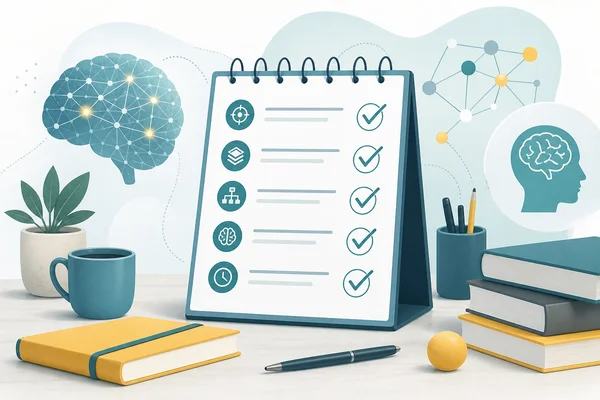
A Simple Cognitive Processes Checklist
Use this checklist when you want to understand a difficult task or a frustrating mental moment.
- What information did I need to notice?
- What did I need to ignore?
- What did I have to hold in working memory?
- What prior knowledge did I need to retrieve?
- Did speed, accuracy, or flexibility matter most?
- Was the task emotionally loaded or socially complex?
- What conditions made it easier or harder?
This kind of reflection can reveal patterns. You may discover that your attention is strong in quiet settings but fragile with notifications, or that your memory is better with written cues than spoken instructions. You may notice that reasoning is fine, but processing speed drops late in the day.
Small adjustments can follow from those observations. You might reduce distractions before deep work, write down multi-step instructions, use checklists for recurring tasks, add breaks between demanding meetings, or practice retrieval instead of rereading when learning. These are not clinical treatment promises; they are practical experiments that reduce unnecessary cognitive load.
Using Cognitive Processes as a Reflection Framework
Cognitive processes are most useful when they help you ask better questions. Instead of wondering whether your brain is simply "sharp" or "foggy," you can ask which part of the process is strained: attention, working memory, speed, reasoning, language, flexibility, or emotional appraisal.
CognitiveAssessment.net is designed around that broader view. Its 25-question online assessment looks across multiple cognitive dimensions and can be repeated over time for trend awareness. If you want to connect the ideas in this article to your own patterns, you can review a cognitive performance snapshot as one low-pressure source of information.
Keep the boundary clear. An online self-assessment can help you reflect, compare domains, and track changes, but it is not a clinical diagnosis or a substitute for professional advice. Used carefully, it can make your observations more organized and your next questions more useful.

FAQ
What are cognitive processes?
Cognitive processes are mental operations used to receive, interpret, store, retrieve, and apply information. They include attention, perception, memory, learning, language, reasoning, processing speed, executive functions, and social or emotional appraisal.
What are the 4 cognitive processes?
A simple four-part model might include attention, perception, memory, and reasoning. This is useful for quick explanations, but it leaves out important areas such as language, processing speed, executive functions, and social cognition.
What are the 5 cognitive processes?
A common five-part answer is attention, perception, memory, language, and thinking or reasoning. In practical brain-health conversations, working memory, processing speed, and executive functions are often discussed separately because they affect daily tasks in different ways.
What are the 8 cognitive processes?
One practical list of eight cognitive processes is perception, attention, working memory, long-term memory, learning, processing speed, executive functions, and language or reasoning. Other lists may group these differently depending on the textbook, workplace training model, or assessment context.
What is cognitive processing speed?
Cognitive processing speed is the efficiency with which you take in information, understand it, and respond. It can vary with fatigue, stress, distraction, task difficulty, and age. Slower processing speed does not automatically mean weaker reasoning.
How are cognitive processes used in learning?
Learning uses attention to notice information, working memory to hold it, long-term memory to connect it with prior knowledge, and retrieval to strengthen access later. Feedback, examples, practice, and sleep can all influence how well learning sticks.
Can cognitive processes change over time?
Yes. Cognitive processes can feel different across the lifespan and from day to day. Sleep, stress, health, environment, habits, and task demands can all play a role. New or disruptive changes deserve careful attention and, when appropriate, professional guidance.
Is an online cognitive assessment the same as a clinical evaluation?
No. An online cognitive assessment can support education, self-reflection, and trend tracking, but it is not a clinical diagnosis and should not replace professional advice. It is best used as one piece of context alongside your own observations.