Clock Test Dementia Guide for Understanding Clock Drawing Results
The phrase clock test dementia usually refers to the clock drawing test, a brief cognitive screening task where a person draws an analog clock and sets the hands to a requested time. It looks simple, but it can reveal how someone uses planning, attention, memory, visual-spatial organization, and executive function at the same time. A single clock drawing cannot explain the cause of cognitive change, and it should not be treated as a stand-alone clinical answer. Still, it can be a useful conversation starter when used with history, observation, and broader cognitive tools such as a multi-domain cognitive self-check.
What the Clock Drawing Test Is
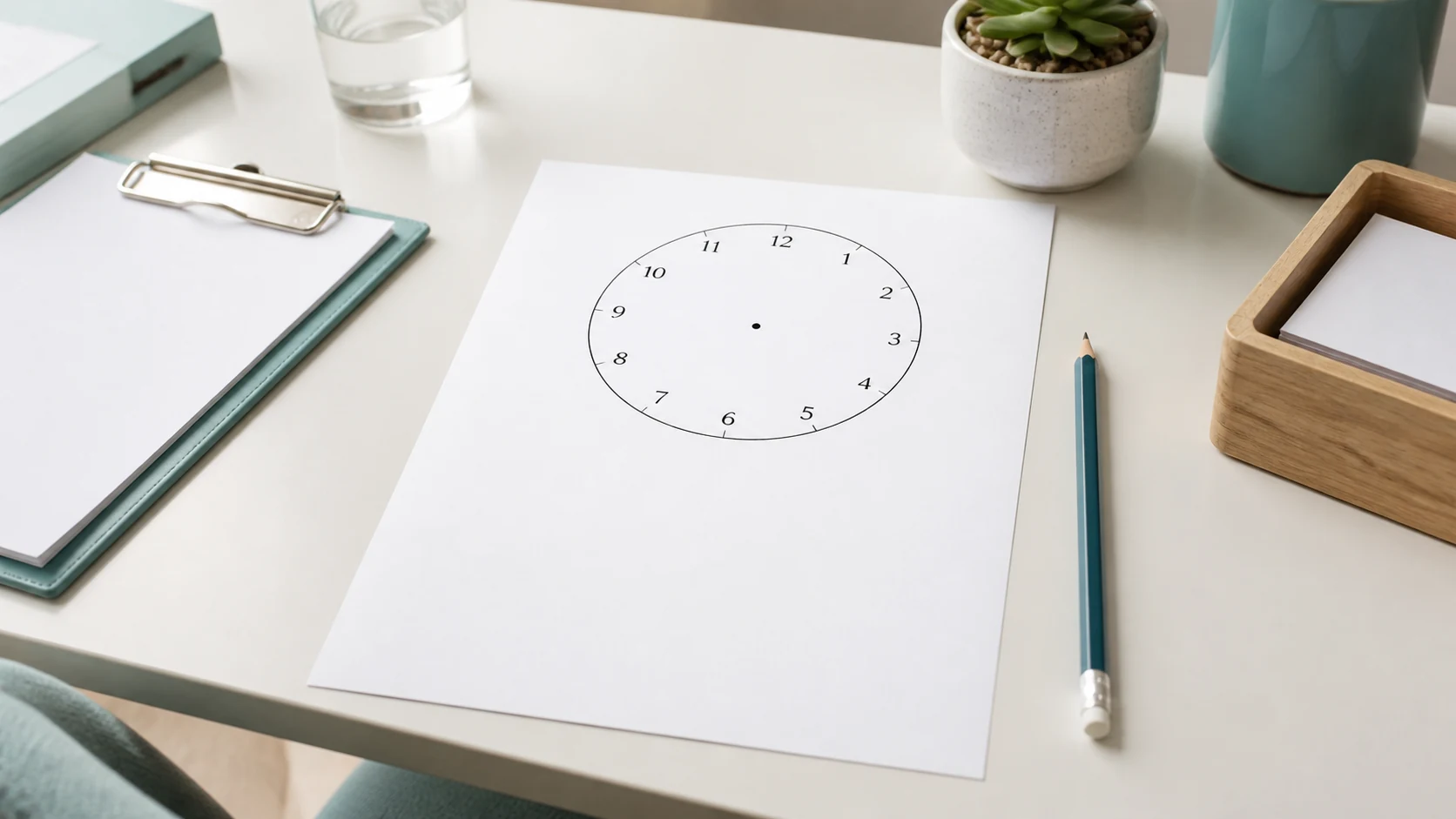
In a common version of the clock drawing test, a person is asked to draw a clock face, place the numbers in order, and set the hands to a specific time, often ten minutes past eleven. Some versions provide a blank page; others provide a pre-drawn circle. The task may appear in a Mini-Cog-style screen, where clock drawing is combined with delayed word recall.
The value of the task is not that clocks are medically special. The value is that drawing a clock compresses several mental operations into one visible action. The person must understand the instruction, remember what an analog clock looks like, plan the number layout, organize space, inhibit mistakes, and translate a time into hand positions. That is why a clock drawing can be informative even though it takes only a few minutes.
It is also why the task has limits. Poor vision, shaky hands, unfamiliarity with analog clocks, anxiety, low literacy, cultural context, medication effects, fatigue, or an acute illness can all affect the result. A careful reader should see the clock drawing test as a screening clue, not as proof of dementia.
What the Test Measures
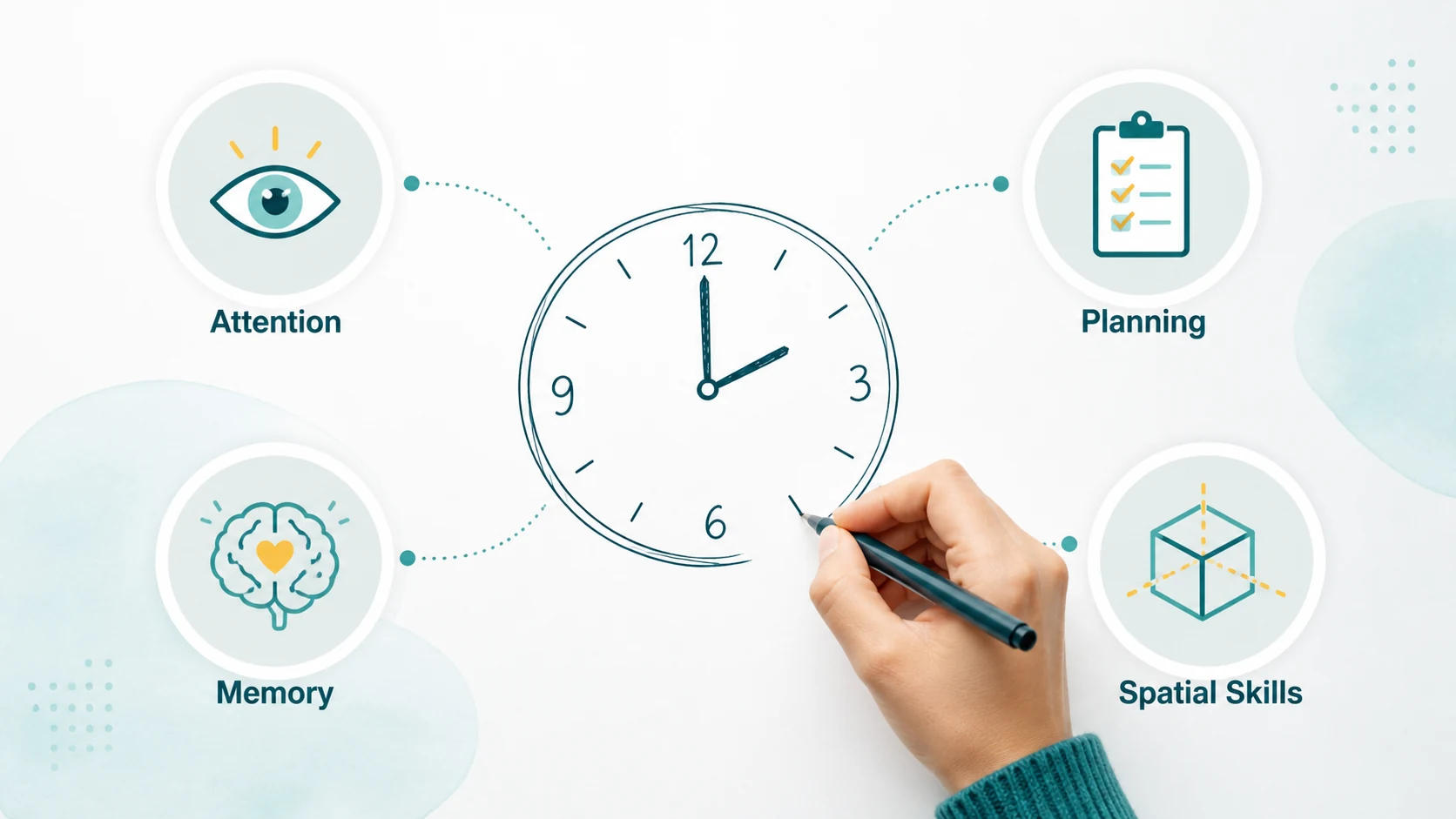
Clock drawing draws on multiple cognitive domains at once. That makes it different from a single memory question.
Executive function is involved because the person has to plan the drawing, sequence steps, monitor errors, and finish the task without drifting away from the instruction. Visual-spatial skill is involved because the numbers must be distributed around a circle in roughly correct locations. Attention matters because skipped numbers, duplicated numbers, or misplaced hands can occur when focus breaks down. Memory also matters, both for recalling the idea of an analog clock and, in Mini-Cog-style use, for remembering words after the drawing task.
This multi-domain nature explains why clock drawing can be relevant to dementia screening. Dementia is not only forgetfulness. It can affect planning, orientation, judgment, visual-spatial reasoning, language, mood, and daily functioning. A clock drawing may show strain in one or more of those areas, especially when compared with a person's usual ability and daily changes noticed by family or clinicians.
Clock Drawing Test Examples and Common Error Patterns
People searching for clock drawing test examples often want to know what a concerning drawing looks like. Examples can be educational, but they should be interpreted carefully. The same visible error can have different causes.
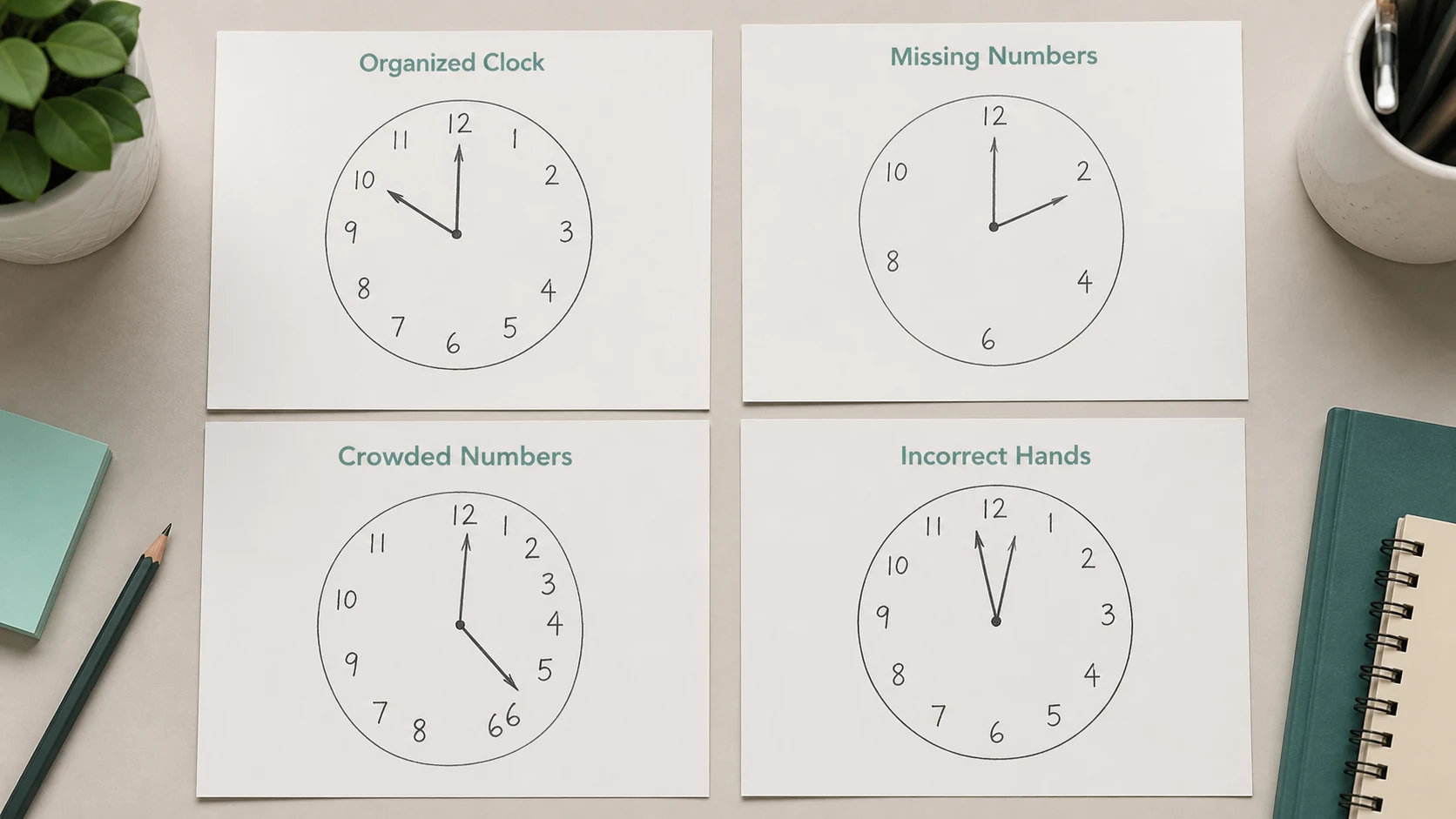
Common error patterns include missing numbers, duplicated numbers, numbers crowded on one side, numbers placed outside the clock face, a clock face that is very distorted, missing hands, more than two hands, hands pointing to the wrong time, or a drawing that does not resemble a clock. Some people preserve the circle but lose the number sequence. Others place the numbers correctly but cannot set the hands. Still others make a small, fragmented, or disorganized drawing.
These patterns may suggest problems with planning, spatial organization, attention, concept formation, or motor control. They do not identify a dementia type by themselves. For example, a spatially crowded drawing could reflect visual-spatial difficulty, neglect after stroke, low familiarity with clock faces, or a rushed attempt. A shaky clock could reflect motor symptoms rather than cognitive decline. A person who refuses or cannot begin may be anxious, confused, tired, depressed, or physically unable to complete the task.
For caregivers, the most useful question is not "Which exact disease does this drawing show?" A better question is "Does this fit a broader change in memory, daily function, attention, navigation, finances, medication management, conversation, or safety?"
How Clock Drawing Test Interpretation Works
Clock drawing test interpretation depends on the scoring system. Some systems use a simple normal/abnormal approach. In the Mini-Cog method, the clock drawing portion is scored as normal or abnormal, then combined with word recall. Other systems assign points for the circle, number order, number spacing, hand placement, and overall organization.
The broad interpretation is usually similar across methods: a well-organized clock with all numbers in order and hands correctly set is reassuring within the limits of a screening task. An abnormal clock suggests that further evaluation may be appropriate, especially if there are real-world concerns. A borderline drawing may need context rather than a quick label.
This is where a broader online cognitive assessment approach can help with self-reflection. A clock drawing mostly emphasizes visual-spatial planning and executive organization. A multi-domain cognitive assessment can separately look at attention, working memory, processing speed, problem-solving, and related patterns. It still does not replace a professional evaluation, but it gives a person more than one signal to think about.
If you are reviewing a clock drawing at home, avoid coaching the person through corrections while treating the result as a screen. Extra hints can change what the task is measuring. Also avoid comparing one person's clock to a random online image as if the match were exact. The more useful record is the instruction given, the drawing itself, the date, the person's condition that day, and any daily-life concerns around the same time.
How Accurate Is the Clock Test for Dementia
The clock test can be useful, but accuracy depends on the population, scoring method, training of the scorer, and whether the goal is to identify established dementia or very mild impairment. Research generally finds that clock drawing performs better for more obvious impairment than for subtle early changes. Digital clock drawing methods may capture timing, pauses, and drawing process data that a final paper drawing misses, but digital methods also need standardization and careful validation.
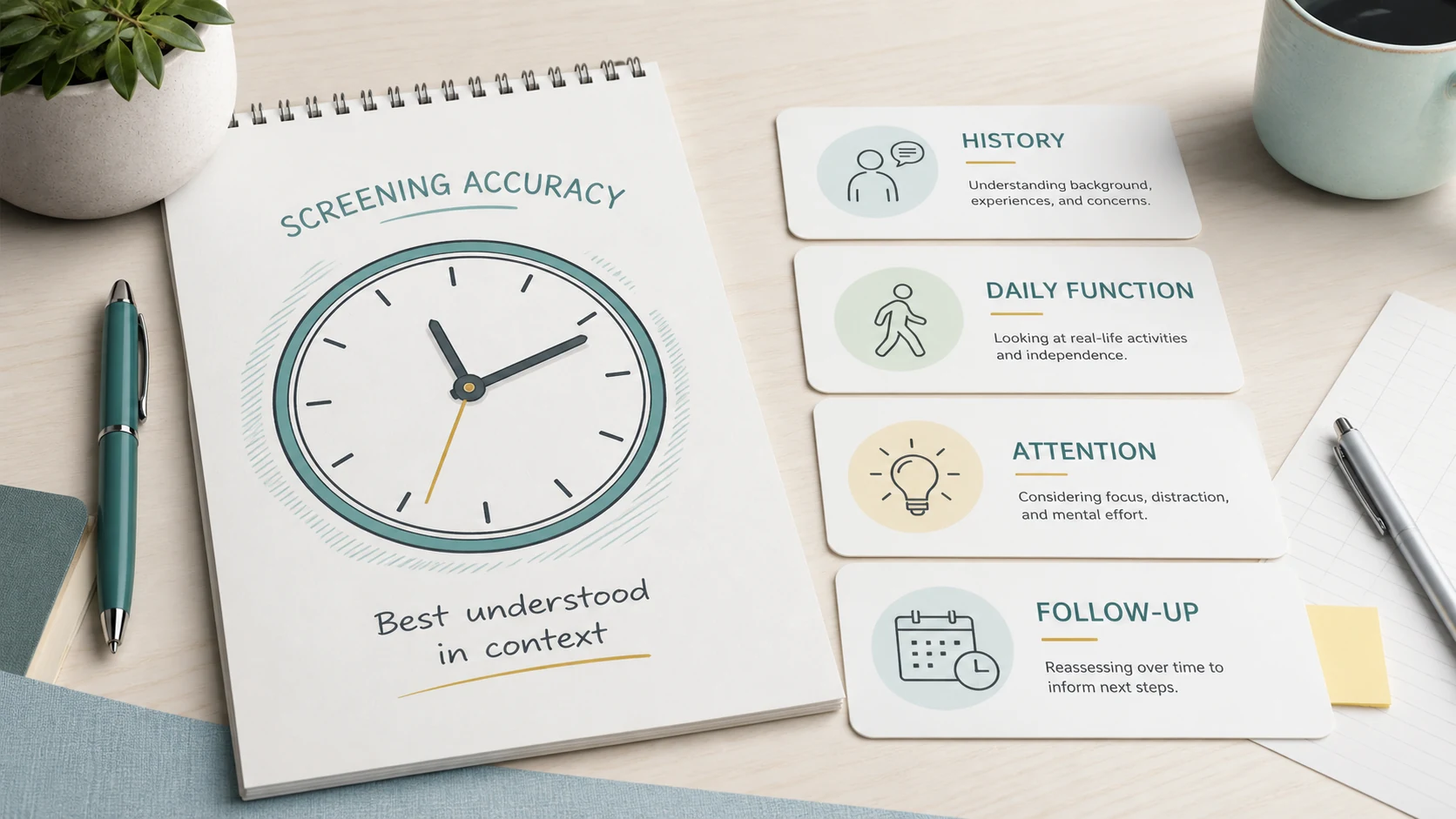
This means two cautions matter. First, a normal clock does not rule out early cognitive change. A person may still have memory, language, attention, mood, sleep, medication, or medical issues that need attention. Second, an abnormal clock does not automatically mean dementia. It means the result deserves context.
For asymptomatic older adults, major preventive-care guidance has also been cautious about universal cognitive screening because evidence about benefits and harms is not settled. That does not mean concerns should be ignored. It means screening should be connected to a thoughtful next step, especially when family members, caregivers, or the person themselves notice changes.
Clock Test PDF and Online Versions What to Know
Searches such as clock test dementia pdf, clock drawing test pdf, and clock drawing test interpretation pdf often come from caregivers, students, or people preparing for a medical appointment. A PDF template can be useful for understanding the task format, especially if it shows the instruction and scoring criteria. But a PDF is not enough to interpret a person's health situation.
If you use a printable template for education, keep the conditions simple. Note whether the person used a blank page or pre-drawn circle. Write down the exact time requested. Avoid repeated practice if the goal is to observe natural performance. Keep the original drawing rather than redrawing it neatly afterward.
Online clock drawing test pages can be convenient, but they vary widely. Some are educational, some are research tools, and some are informal quizzes. Before relying on one, ask what it measures, whether it explains limitations, whether it stores personal information, and whether results are framed as screening rather than certainty. For sensitive health-related questions, privacy and language boundaries matter as much as convenience.
Schizophrenia Clock Test and Other Non-Dementia Uses
The phrase schizophrenia clock test appears in keyword tools because clock drawing has been studied across several neurological and psychiatric conditions. The task can reflect executive function, planning, and visual organization, which may be affected in conditions beyond dementia.
That does not make clock drawing a condition-specific tool. A similar drawing error can appear for different reasons in different people. Stroke, Parkinsonian conditions, delirium, traumatic brain injury, depression, psychosis, medication effects, and visual or motor impairment can all influence performance. In schizophrenia research or clinical contexts, clock drawing may be one small part of understanding cognition, but it is not a stand-alone explanation of symptoms.
For general readers, the practical takeaway is simple: the clock drawing test is best understood as a quick window into cognitive process, not as a single-condition answer. It becomes more meaningful when combined with history, functional changes, other cognitive measures, and professional judgment.
Using Clock Test Dementia Results as One Cognitive Signal
If a clock drawing result worries you, step back and look for patterns. Has the person also become lost in familiar places? Are bills, medications, appointments, cooking steps, or conversations becoming harder? Are changes gradual, sudden, or fluctuating? Sudden confusion, severe sleepiness, fever, medication changes, dehydration, head injury, or new neurological symptoms should be handled promptly with medical help.
For gradual concerns, save the drawing, write down the date and instruction, and discuss it with a qualified health professional. Bring examples of daily changes rather than only the clock image. A clinician may use additional cognitive screens, medical history, medication review, lab work, neurological exam, mood screening, imaging, or referral when appropriate.
For people who are curious about their broader cognitive profile, a cognitive tracking and self-reflection habit can add context over time. Repeating structured self-checks under similar conditions may help you notice trends in attention, memory, processing speed, or executive function. The clock test dementia topic is useful because it shows how much one small task can reveal, but the wisest interpretation is still cautious, contextual, and connected to real-world functioning.

FAQ
What does it mean if you fail the clock test?
It means the drawing did not meet the expected criteria for that version of the task. The result may suggest difficulty with planning, attention, visual-spatial organization, memory, or understanding the instruction. It should lead to context and, when concerns are real, professional evaluation. It should not be used alone to decide what condition someone has.
What is the 12 question dementia test?
People may use this phrase for different brief cognitive or caregiver questionnaires. Some tools ask a small set of questions about memory, orientation, daily function, or recent changes. The exact meaning depends on the named tool, the scoring method, and who is meant to complete it. If a test is being used for health decisions, ask for the official name and scoring guidance.
What are the four types of cognitive impairment?
There is no single universal four-type list used in every setting. People may group cognitive impairment by severity, such as mild cognitive impairment and dementia, or by affected domains, such as memory, attention, executive function, language, and visual-spatial skills. Clinicians usually interpret impairment by pattern, cause, daily impact, and change over time.
What is the 2 finger test in dementia?
This phrase is not as standardized as the clock drawing test. It may refer to a simple instruction-following or motor imitation task used during a neurological or cognitive exam. Because names vary, the safest approach is to ask which specific exam or protocol is being referenced and how the result is scored.
Can I use a clock drawing test PDF at home?
You can use a PDF to understand the task format or prepare questions for an appointment. If you are observing someone, record the exact instruction, keep the original drawing, and avoid repeated coaching. A home PDF result should be treated as an observation to discuss, not as a final clinical answer.
Is the clock drawing test online reliable?
Online versions vary. A well-designed online tool should explain what it measures, how privacy is handled, what the limits are, and when to seek professional help. Be cautious with any page that turns one drawing into a certain health claim or ignores vision, motor, education, culture, and context.
Why is ten minutes after eleven often used?
That time requires the person to place the minute hand at the 2 and the hour hand near 11, which tests more than simply drawing two hands. It also reduces the chance that someone can succeed by drawing a familiar straight-up or straight-across hand position.