Attention Assessment Test: Evaluating Focus in Our Digital World
In our always-connected digital environment, focus has become a rare and valuable skill that directly impacts our productivity and well-being. Every day, we are bombarded by a never-ending stream of notifications, emails, and social media alerts. This constant noise makes it harder than ever to concentrate on the tasks that truly matter. Have you ever wondered why it is so difficult to stay on track during a long meeting or while reading a book? Is your brain struggling to keep up with the demands of the digital age?
Understanding how your mind handles these distractions is the first step toward reclaiming your productivity. An attention assessment test can provide the clarity you need to understand your current mental performance. By identifying your specific strengths and weaknesses, you can take proactive steps to improve your concentration and overall brain health. If you are ready to see how your mind performs, you can start a test today to get a baseline of your cognitive abilities.
This article explores the critical importance of attention assessment in our increasingly distracted environment. We will look at the different types of focus, how digital tools measure these skills, and what you can do to strengthen your mental endurance.

Understanding the Different Types of Attention
Attention is not a single, simple function. It is a complex set of processes that allow us to interact with the world. To understand how an attention assessment test works, we must first break down the different ways our brains process information. Scientists generally categorize attention into several distinct types, each serving a unique purpose in our daily lives.
Sustained Attention: The Ability to Maintain Focus Over Time
Sustained attention is what most people mean when they talk about "concentration." It is the ability to focus on a single task or activity for a long period without becoming distracted. Think about a student studying for an exam or a programmer writing lines of code. Both require the brain to stay "locked in" on one objective.
In our digital world, sustained attention often suffers first. We've grown accustomed to quick information bursts, making long-form tasks feel exhausting. Measuring this helps you understand if your "mental battery" for focus is as strong as it needs to be. Many users find that taking an online assessment helps them realize when their focus starts to dip during the day.
Selective Attention: Filtering Out Irrelevant Information
Selective attention is the brain's ability to "tune out" the noise. Imagine sitting in a busy coffee shop. People are talking, music is playing, and coffee machines are whirring. Despite all this, you can still have a conversation with a friend. Your brain is selectively attending to your friend’s voice while filtering out the background noise.
This skill is crucial because our environment is full of "irrelevant" data. If your selective attention is weak, you might find yourself easily distracted by a bird outside the window or a quiet hum from the air conditioner. Assessing this ability helps determine how well you can protect your focus from external interruptions.
Alternating Attention: Shifting Between Tasks and Focus
Alternating attention is often confused with multitasking, but it is actually about mental flexibility. It is the ability to move your focus from one task to another and then back again. For example, you might be typing a report, stop to answer a quick phone call, and then immediately return to the exact spot where you left off in your report.
In a fast-paced work environment, this skill is essential. However, constant task-switching can lead to "attention residue." This happens when your mind is still thinking about the previous task while you try to do the new one. Evaluating your alternating attention can show how efficiently your brain handles transitions.
How Attention Assessment Tests Work in Digital Environments
In the past, testing cognitive skills required physical appointments and paper-and-pencil tasks. Today, technology has changed the landscape. Digital environments allow for much higher precision and real-time data analysis. An attention assessment test delivered online can measure reaction times down to the millisecond, providing insights that a human observer might miss.
The Science Behind Digital Attention Evaluation Methods
Digital assessments are built on decades of neuropsychological research. These tests often use "Continuous Performance Tasks" or "Go/No-Go" paradigms. In these tasks, you are asked to respond to a specific stimulus while ignoring others. The software tracks not just whether you got the answer right, but how long it took you to decide.
By using artificial intelligence, platforms can now analyze patterns in your responses. AI can distinguish between a simple mistake caused by a fast reflex and a deeper lapse in concentration. This level of detail makes it possible to check your brain performance with a degree of accuracy that was once only available in clinical research labs.
Online Focus Tests: What to Expect and How They Measure Your Attention
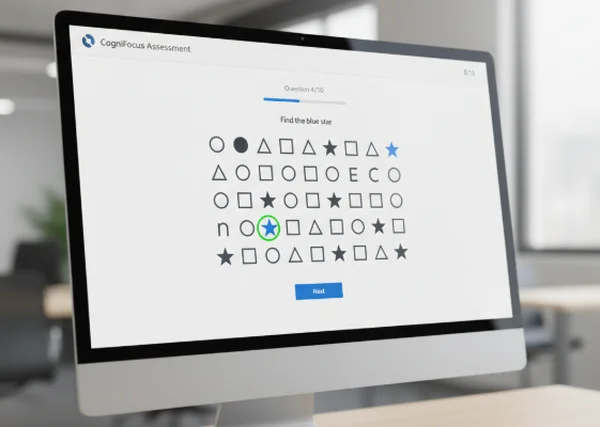
When you take an online focus test, you will usually engage in a series of game-like challenges. These might involve clicking when a certain shape appears or remembering a sequence of numbers. While they may seem simple, they are designed to push your cognitive limits.
The test measures several key metrics:
- Response Consistency: How steady is your focus over several minutes?
- Accuracy: How many errors do you make when the task gets faster?
- Omission Errors: Did you miss a target because you weren't paying attention?
- Commission Errors: Did you click when you weren't supposed to because you were impulsive?
The system combines these data points to generate a personalized report. This report explains your cognitive profile in plain English.
Digital Distraction and Its Impact on Cognitive Performance
We live in an age of "continuous partial attention." We are rarely fully present in one task because a part of our brain is always waiting for the next digital "hit." This environment has a profound impact on how our brains function on a daily basis.
How Technology is Rewiring Our Attention Spans
Research suggests that the frequent use of high-speed digital media may be changing the way our brains process information. We've become accustomed to instant gratification through short videos. This habit may be reducing our patience for tasks requiring deep, slow thinking.
This "rewiring" isn't necessarily permanent, but it does mean our brains are becoming optimized for scanning rather than focused immersion. This is why many people feel a sense of "brain fog" after spending hours on their phones. They have spent all their mental energy on shallow processing, leaving nothing left for deep work.
Recognizing Signs of Attention Deficit in a Digital World
It is important to distinguish between occasional distractibility and a significant decline in cognitive performance. Many adults worry they are developing attention issues as they age. Some common signs that your focus may be struggling include:
- Finding it impossible to read more than two pages of a book without checking your phone.
- Entering a room and forgetting why you went there.
- Making frequent small mistakes in tasks you have done many times before.
- Feeling overwhelmed by simple decisions.
If these signs feel familiar, it might be time to measure your focus to see if these are normal variations or something that requires more attention.
Practical Strategies for Improving Your Concentration
Fortunately, our brains have an amazing ability to adapt and improve with the right training and habits. Just as you can train your muscles at the gym, you can train your "attention muscles" through specific habits and techniques.
Evidence-Based Techniques for Enhancing Sustained Attention
One of the most effective ways to improve focus is through "monotasking." This is the practice of doing exactly one thing at a time. Research shows that multitasking can actually decrease productivity by up to 40%. By focusing on one task, you allow your brain to enter a "flow state" where work becomes easier and more efficient.
Another proven technique is mindfulness meditation. Even five to ten minutes of sitting quietly and focusing on your breath can strengthen the neural pathways associated with selective attention. This practice teaches your brain to notice a distraction and then gently let it go.
Creating a Focused Environment in Our Digital Age
Your environment significantly impacts your concentration. Even if your phone is face down on your desk, part of your brain still expends energy trying to ignore it. To create a "focus-friendly" space:
- Physical Distance: Put your phone in another room during deep work sessions.
- Visual Clutter: Keep your desk clean. A cluttered space can lead to a cluttered mind.
- Digital Hygiene: Use "Do Not Disturb" modes on your computer to block pop-up notifications.
Small changes in your physical space can lead to big improvements in your attention assessment test scores over time.

Digital Tools and Apps That Can Help Train Your Attention
While technology is often the source of distraction, it can also be part of the solution. There are many tools designed to help you regain control. Some apps block distracting websites for set periods, while others provide "white noise" to help with selective attention.
However, the most important tool is one that provides objective data. You cannot improve what you do not measure. By regularly using a cognitive tool, you can track your progress and see which strategies are actually working for you.
Your Next Steps in Understanding and Improving Your Attention
Your attention is a finite resource that's increasingly under siege in our digital landscape. Understanding and protecting your focus isn't just about productivity—it's essential for maintaining mental clarity. We have explored how different types of attention allow us to function and how digital distractions can wear those functions down.
The path to better focus starts with awareness. By taking an attention assessment test, you move from guessing about your brain health to knowing the facts. Whether you are a professional looking to boost productivity or a senior concerned about memory and focus, objective data is the key to improvement.
Ready to break free from distraction? By taking just a few minutes to evaluate focus, you'll gain valuable insights that can transform how you work and think. It's time to take control of your attention.
The Takeaway
What is an attention assessment and why is it important?
An attention assessment is a scientifically designed evaluation that measures how well your brain can focus, filter out distractions, and switch between tasks. It is important because attention is the foundation of all other cognitive functions. Without good focus, it is difficult to learn new things, remember information, or solve complex problems. Understanding your attention profile helps you identify areas for improvement. You can try a test to see where you stand.
How can I evaluate my focus at home without professional tools?
While a professional-grade online tool provides the most accurate data, you can look for "red flags" at home. Try to read a difficult article for 15 minutes without looking at your phone or getting up. If you find your mind wandering more than three or four times, your sustained attention might need some work. However, for a precise measurement of reaction time and accuracy, a digital assessment is recommended.
What happens if attention assessment tests reveal potential deficits?
First, do not panic. An assessment tool is a way to gain clarity, not a final medical diagnosis. If the results show that your focus is lower than average for your age group, it often serves as a "wake-up call" to improve your lifestyle habits, such as sleep, nutrition, and stress management. Many people use these results as a starting point to talk with their doctor or to begin targeted brain training exercises. You can see your results immediately after finishing a session on our platform to begin your journey toward better brain health.