Cognitive Assessment: Questions Asked & Examples
Feeling anxious about an upcoming Cognitive Assessment? You're not alone. Many people wonder, what questions are asked in a cognitive assessment? The uncertainty can be stressful, but understanding the process is the first step toward confidence. This guide will demystify the types of questions and tasks used to evaluate your memory, attention, and executive functions. By the end, you'll not only feel more prepared but also understand how our advanced, AI-driven tool can offer precise insights into your unique cognitive profile. Ready to begin? You can explore your cognitive profile today.
Understanding Cognitive Assessment Questions
Before we dive into specific examples, it’s crucial to understand what a cognitive assessment is and why the questions are designed the way they are. This isn't about passing or failing; it's about creating a detailed map of your mental strengths and areas that might need more support. The goal is empowerment through understanding.
What is a Cognitive Assessment? Beyond Simple Memory Tests
A cognitive assessment is much more than a simple quiz or memory test. It is a comprehensive evaluation designed by experts, like neuropsychologists, to measure how your brain processes information. Think of it as a workout for your mind, where different exercises target specific cognitive "musles." These evaluations look at multiple areas, including how you learn, remember, focus, reason, and solve problems.
Unlike a standard academic test that measures knowledge, a cognitive assessment measures your underlying abilities. It provides a snapshot of your brain health and efficiency. Modern platforms like our online cognitive assessment use tasks based on clinically validated principles to provide a multi-dimensional view of your abilities, going far beyond a simple score. This is where you can gain actionable insights from a brief cognitive assessment tool.
Why Are These Questions Important? Measuring Key Cognitive Domains
Each question or task in a cognitive assessment is carefully selected to measure specific cognitive domains. These are distinct categories of mental skills that work together to help you navigate daily life. By testing each domain, an assessment can identify not just if you're facing a challenge, but where that challenge might originate.
For example, forgetting where you placed your keys could be a memory issue, an attention lapse, or even a problem with executive function (planning). A well-designed test can help pinpoint the source. This detailed feedback is vital for creating effective strategies to support your brain health. Ultimately, a modern online cognitive assessment aims to provide you with clarity and a clear path forward.
Common Cognitive Assessment Examples & Task Types
Now, let's explore some of the common task types you might encounter. While the exact format can vary, the underlying principles are often similar. These examples will give you a clear idea of what to expect from a comprehensive cognitive assessment test.
Memory Assessment: Recalling Information & Patterns
When people hear "memory test," this is often the first thing that comes to mind. These tasks evaluate both short-term and long-term memory, as well as your ability to learn new information.
-
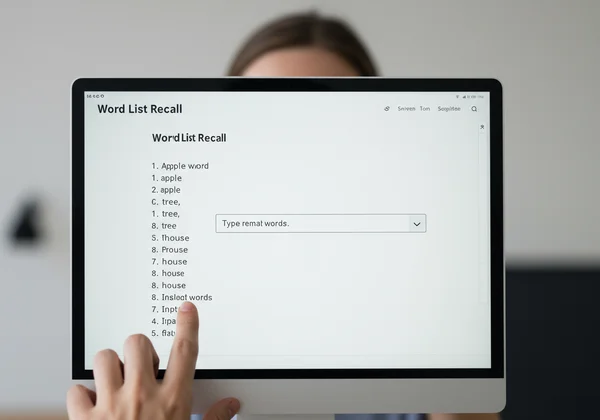
Word List Recall: You might be presented with a list of 10-15 words and asked to recall as many as you can, both immediately and after a delay. This tests your ability to encode and retrieve new information.
-
Story Recall: You will listen to a short story and then be asked to retell it with as much detail as possible. This assesses your auditory memory and comprehension.
-
Visual Pattern Recognition: You may be shown a complex geometric shape, which is then hidden. You'll then have to draw it from memory or pick it out from a set of similar images.
Attention & Concentration Tasks: Focusing Amidst Distractions
Your ability to focus is fundamental to all other cognitive functions. These tasks measure how well you can maintain concentration and filter out irrelevant information.
- Continuous Performance Test: You might be asked to watch a series of letters or numbers appear on a screen and press a button only when you see a specific target (e.g., the letter "X"). This measures sustained attention and impulse control.
- Symbol Search: This task involves quickly scanning rows of symbols to see if a target symbol is present. It’s a measure of your processing speed and focused attention.
- Auditory Attention: You may listen to a list of letters and be asked to tap the table every time you hear the letter "A." This tests your ability to focus on auditory cues.
Executive Function Challenges: Planning, Problem-Solving & Flexibility
Executive functions are the high-level mental skills that help you plan, organize, manage your time, and switch between tasks. They are your brain's "CEO."
- Trail Making Test: This task requires you to connect a series of dots in a specific order (e.g., alternating between numbers and letters like 1-A-2-B-3-C). It assesses cognitive flexibility and processing speed.
- Verbal Fluency: You could be asked to name as many animals as you can in 60 seconds, or words that start with the letter "F." This measures your ability to retrieve information from your mind quickly and efficiently.
- Problem-Solving Scenarios: Some tests present hypothetical real-world problems and ask you to outline the steps you would take to solve them, evaluating your planning and reasoning abilities.
Language & Visual-Spatial Skills: Words, Shapes & Recognition
This part of a cognitive skills assessment test evaluates your ability to understand and express language, as well as perceive the relationships between objects in space.
- Object Naming: You might be shown pictures of common objects and asked to name them. This assesses your ability to access your vocabulary.
- Block Design: This classic task involves using a set of colored blocks to replicate a pattern shown on a card. It is a powerful measure of visual-spatial reasoning and problem-solving.
- Clock Drawing: A common task, especially in an elderly cognitive assessment, is to draw a clock face showing a specific time. This simple-sounding task integrates visual-spatial skills, planning, and numerical knowledge.
Preparing for Your Assessment & Managing Expectations
Now that you know what to expect, how can you prepare? The goal of a cognitive assessment isn't to get the highest score possible, but to get the most accurate score. This means showing up as your true self.
Tips for Approaching Your Cognitive Assessment
The best cognitive assessment practice has less to do with studying and more to do with your mindset and physical state. Here are a few tips:
- Get a Good Night's Sleep: Being well-rested ensures your brain is operating at its typical capacity. Fatigue can significantly impact attention and memory.
- Stay Calm and Relaxed: Anxiety can interfere with performance. Remember, this is a tool for insight, not a judgment. Breathe deeply and approach each task with a clear mind.
- Don't Be Afraid to Ask Questions: If you are taking the test in a clinical setting, clarify any instructions you don't understand. If you're using an online tool like ours, read the instructions carefully before beginning each section.
- Don't Guess Randomly: If you genuinely don’t know an answer, it’s better to say so or move on. An accurate report depends on honest responses.
How AI Delivers Personalized Insights from Your Results
After completing the tasks, what happens next? This is where modern cognitive assessment tools shine. On our platform, our AI-powered engine analyzes your unique response patterns—not just your final answers. It looks at your timing, your error types, and how your performance varies across different domains.
This deep analysis allows us to generate a highly personalized report that goes beyond a simple number. It translates your data into clear strengths, potential challenges, and actionable recommendations tailored to you. It’s the difference between being told your score and understanding what it means for your daily life. Get your detailed report to see how it works.

Your Path to Deeper Cognitive Understanding
Understanding the questions and tasks involved in a cognitive assessment is the first step in taking control of your brain health. It’s not a scary, mysterious process but a structured way to gain incredible insight into your mind's inner workings. Whether you are proactively managing your well-being, exploring a concern, or seeking to enhance your mental performance, a reliable assessment is an invaluable tool.
Are you ready to move from wondering to knowing? Discover your cognitive strengths and challenges with a scientifically designed, AI-powered evaluation. Start your free assessment and embark on a journey to better brain health today.
Frequently Asked Questions About Cognitive Assessments
Why would someone need a cognitive assessment?
People seek cognitive assessments for many reasons. Some are proactive self-testers curious about their brain health. Others may be concerned about memory changes for themselves or a loved one. Professionals also use these tools for clinical screening or research. Ultimately, it’s for anyone who wants objective data about their mental performance and actionable insights for improvement.
How can I test my cognitive ability at home?
You can easily and reliably test your cognitive ability at home using a scientifically designed online platform. Tools like our scientifically designed cognitive assessment are created by neuropsychologists and AI experts to provide a comprehensive evaluation from the comfort of your own space. Our platform guides you through a series of tasks to create a detailed report on your cognitive profile.
What happens if you get a low score on a cognitive test?
A low score is not a final judgment; it's a data point. It provides valuable information about an area that may require more support. A good assessment report will not just give you a score but will also offer context and suggest actionable steps, such as lifestyle changes, specific mental exercises, or a recommendation to consult with a healthcare professional for further evaluation. Remember, this is a tool for insight, not a diagnosis.
At what age should you consider a cognitive test?
There is no "right" age. While concerns about cognitive decline often increase for those over 50, a cognitive test is beneficial for adults of all ages. A lifelong learner might use it to optimize study habits, while a professional might take one to manage workplace stress. Establishing a baseline assessment early can also be helpful for tracking changes over time. You can get a brain health check at any stage of life.